

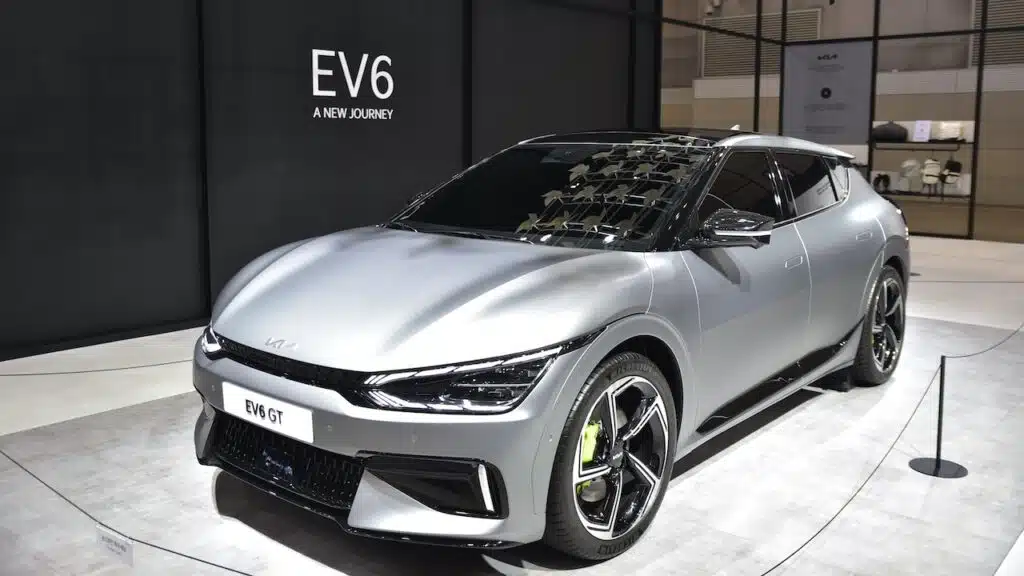
Hyundai class action lawsuit overview:
- Who: Plaintiffs Hayes Young and Roy A. Williams filed a class action lawsuit against Hyundai Kefico Inc.
- Why: Young and Williams claim Hyundai Kefico failed to disclose that its integrated charging control units (ICCU) have a defect that can cause them to fail.
- Where: The Hyundai class action lawsuit was filed in New Jersey federal court.
A new class action lawsuit alleges Hyundai failed to disclose that its integrated charging control units have a defect that can cause them to fail, resulting in a loss of power and an increased risk of a crash.
Plaintiffs Hayes Young and Roy A. Williams claim Hyundai failed to disclose the ICCU defect to consumers, resulting in them purchasing vehicles that are worth “substantially less” than what they paid for them.
Young and Williams want to represent a nationwide class and two state sub-classes of consumers who purchased or leased a Hyundai, Genesis or Kia EV6 vehicle that contained a defective ICCU.
“The defective ICCUs are prone to fail which results in or is caused by an open ICCU fuse which results in an inability to charge the 12-volt battery after which motive power will fail as the battery drains,” the Hyundai class action lawsuit says.
Class action claims Kia EV6 and other vehicles can lose power
Young and Williams argue the ICCU defect can cause the battery’s state-of-charge to deplete rapidly, resulting in a loss of power and an increased risk of a crash.
The plaintiffs claim Hyundai’s ICCU design combines on-board charging with vehicle control and DC converter functionalities, which, they argue, increases the risk of power loss in the event of a failure.
Other electric vehicles, meanwhile, have separate components for these functions, allowing for cheaper repairs and reducing the risk of power loss, according to the Hyundai class action lawsuit.
“Hyundai has heretofore refused to replace the ICCU probably due to the fact that defendant only produces defective ICCUs,” the Hyundai class action alleges.
Young and Williams claim Hyundai is guilty of unjust enrichment and violating the consumer protection laws of New Jersey and Kentucky, among other things, and are demanding a jury trial, declaratory and injunctive relief and an award of compensatory damages for themselves and all class members.
Last year, Kia was hit with a lawsuit claiming the company knowingly sold 2021–2023 Soul and Seltos vehicles with a defect that can result in engine failure and potential fire.
Did you purchase or lease a Hyundai, Genesis or Kia EV6 vehicle with a defective ICCU? Let us know in the comments.
The plaintiffs are represented by Lee Squitieri of Squitieri & Fearon LLP.
The Hyundai class action lawsuit is Young, et al. v. Hyundai Kefico Inc., Case No. 3:26-cv-04198, in the U.S. District Court for the District of New Jersey.
Don’t Miss Out!
Check out our list of Class Action Lawsuits and Class Action Settlements you may qualify to join!
Read About More Class Action Lawsuits & Class Action Settlements:
- GM class action alleges defective 10-speed transmissions cause shifting issues, power loss
- Generac recalls nearly 150K portable generators due to fire hazard
- Audible users seek to certify class over audiobook credits that allegedly expire
- Lemonade to pay $10.5M to settle data breach class action over driver’s license data

Debt collection lawsuit investigation: Comenity (Bread Financial), Capital One, Discover, Merrick Bank, First PREMIER Bank, Concora Credit, Continental Finance, Mission Lane, Fortiva, OneMain
October 13, 2026 | Legal News




2 thoughts onHyundai class action alleges Kia ICCU design defect causes power loss
I have an Ioniq 5 and have replaced the battery twice since buying it as the original owner..
2025 Ioniq 5 Limited. Purchased brand new but within a month the 12 volt battery kept dying if the car was not left connected to my level 2 charger. Happened numerous times over the course of the next eight months until they finally replaced the battery in early 2026. We has AAA out numerous times, once having to have it towed to the nearest dealer because they couldn’t get it started. Another time they kept it for a week to monitor the battery. In all these instances they said the battery checked out fine. We were advised by several acquaintances that ICCU was failing to charge the battery when not plugged in.