Promotional or spam text messages sent outside TCPA quiet hours may violate federal law — and you may have a claim.
Individuals who received marketing text messages before 8 a.m. or after 9 p.m. local time may qualify to take part in a TCPA quiet hours lawsuit and seek up to $1,500 in statutory damages per text message.
What to know about the TCPA quiet hours lawsuit investigation
- Core Issue: The Telephone Consumer Protection Act (TCPA) prohibits companies from sending promotional spam text messages before 8 a.m. or after 9 p.m. local time. Attorneys are investigating whether businesses that sent marketing texts during these restricted TCPA quiet hours violated federal law.
- Who it Affects: Consumers in Arkansas, California, Colorado, Florida, Iowa, Kansas, Michigan, Minnesota, Missouri, Nebraska, North Dakota, Oklahoma, Pennsylvania, Rhode Island, Tennessee, Texas and West Virginia who received promotional or spam text messages before 8 a.m. or after 9 p.m. local time.
- Harm/Impact: After-hours marketing texts can disrupt sleep, work and personal time.
- Legal Status: Attorneys are actively investigating claims involving promotional text messages allegedly sent during TCPA quiet hours.
- Take Action: If you received spam text messages before 8 a.m. or after 9 p.m., complete the form on this page to find out whether you may qualify to participate in the TCPA quiet hours lawsuit investigation.
What is a TCPA quiet hours lawsuit?
The Telephone Consumer Protection Act (TCPA) established several rules regarding telemarketing, including when companies can call or send marketing text messages. Under this law, businesses may not contact consumers before 8 a.m. or after 9 p.m. in the recipient’s local time zone.
Despite these restrictions, many consumers report receiving marketing texts during these prohibited TCPA quiet hours. Attorneys are investigating whether the companies that sent these after-hours messages violated the law and whether affected consumers may have legal claims.
These TCPA quiet hours lawsuits allege that:
- Companies sent promotional or spam text messages during TCPA quiet hours.
- The messages may have violated the TCPA.
- Consumers who received the messages may be entitled to seek statutory damages under the TCPA.
The investigation will help determine whether consumers who received after-hours promotional text messages may have claims under the TCPA.
Who qualifies for the TCPA quiet hours lawsuit investigation?
You may qualify to participate in the TCPA class action lawsuit investigation if:
- You live in Arkansas, California, Colorado, Florida, Iowa, Kansas, Michigan, Minnesota, Missouri, Nebraska, North Dakota, Oklahoma, Pennsylvania, Rhode Island, Tennessee, Texas or West Virginia.
- You received promotional or spam text messages before 8 a.m. or after 9 p.m. in your local time zone.
Time limits may apply. Do not wait to check whether you may qualify.
Legally reviewed by: Mario Molina
Shareholder, Property Litigation Group, PLLC
Legally reviewed by: Anthony Pastor
Lead Attorney, Rights & Recovery Law LLP
The law firms responsible for the content of this page are: Property Litigation Group, PLLC; Miramar, FL; 305-506-4746; plgdamage.com; and Rights & Recovery Law LLP; Miami, FL; 786-502-9533; rightsandrecoverylaw.com.
Case updates
Legal status as of August 2026
- Attorneys are actively investigating claims involving spam text messages that were allegedly sent during TCPA quiet hours.
- While this TCPA class action lawsuit investigation is ongoing, several companies — including Lenovo and Navient — have faced TCPA lawsuits for allegedly contacting consumers during unlawful times.
This page was last reviewed and updated in August 2026 to reflect the latest case developments.
What is the Telephone Consumer Protection Act (TCPA)?
The Telephone Consumer Protection Act (TCPA) is a federal law that regulates how and when companies may contact consumers for telemarketing purposes. The law establishes rules for marketing calls and promotional spam text messages to help protect consumers from unwanted communications.
Among other things, the TCPA:
- Restricts the use of certain automated calling and texting technologies.
- Requires companies to obtain consent before sending certain marketing communications.
- Establishes the National Do Not Call Registry.
- Limits when businesses may send telemarketing messages by establishing TCPA quiet hours.
What are TCPA quiet hours?
TCPA quiet hours are the times when businesses generally cannot contact consumers with spam text messages or calls. Under the TCPA, companies are prohibited from sending marketing communications before 8 a.m. or after 9 p.m. in the recipient’s local time zone.
Depending on the circumstances, each after-hours text message or call may constitute a separate violation that could entitle eligible consumers to seek statutory damages.
What should you do if you receive texts during TCPA quiet hours?
If you received promotional or spam text messages before 8 a.m. or after 9 p.m., save any messages or screenshots that show the sender, message content, date and time. This documentation may help attorneys determine whether the texts violated the Telephone Consumer Protection Act (TCPA).
FAQs
Do TCPA quiet hours apply to text messages?
Yes. The Telephone Consumer Protection Act (TCPA) limits when companies can send promotional or marketing text messages.
Does each text message count as a separate TCPA violation?
Depending on the circumstances, each promotional text message allegedly sent during TCPA quiet hours may constitute a separate violation of the TCPA. Eligible consumers may be able to seek up to $1,500 in statutory damages for each qualifying text.
What types of text messages may violate TCPA quiet hours?
The investigation focuses on promotional or marketing text messages, such as sale announcements, discount offers, special promotions and other advertising messages sent before 8 a.m. or after 9 p.m. local time.
Can I still qualify if I deleted the text messages?
Yes. While screenshots or saved text messages may help support a claim, you should not assume you are ineligible if you no longer have them. Complete the form to determine whether your situation may qualify for the investigation.
Fill out the form on this page to see if you qualify for a free case evaluation.
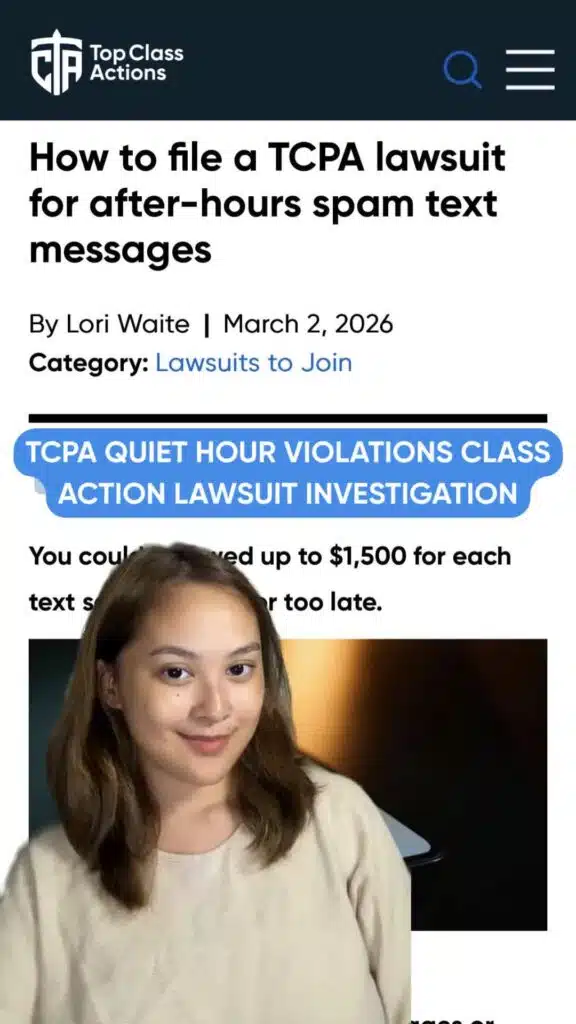
@topclassactions 🚨 LATE NIGHT SPAM? It’s not just annoying—it might be ILLEGAL. 🚨 If you’ve received a marketing text while you were trying to sleep or before you even had your morning coffee, you could be entitled to $500 to $1,500 PER TEXT. 💸 Click the Link in Bio to join the TCPA Quiet Hours investigation! #SpamTexts #TCPA #ClassAction #QuietHours #ConsumerRights #MoneyTips #LawsuitAlert #LegalHelp #StopSpam
♬ original sound – Top Class Actions – Top Class Actions
After you fill out the form, an attorney(s) or their agent(s) may contact you to discuss your legal rights.
ATTORNEY ADVERTISING
The choice of a lawyer is an important decision and should not be based solely on advertisements.
PAID ATTORNEY ADVERTISEMENT: THIS WEB PAGE IS AN ADVERTISEMENT AND THE PARTICIPATING ATTORNEY(S) ARE INCLUDED BECAUSE THEY PAY AN ADVERTISING FEE. Top Class Actions is not a law firm, lawyer referral service, or prepaid legal services plan. We do not endorse or recommend any third-party claims processing company, lawyer, or law firm who participates in the network. We do not make any representation, and have not made any judgment, as to the qualifications, expertise, or credentials of any participating lawyer or processing group. No representation is made that the quality of the legal services or claims processing to be performed is greater than the quality of legal services or claims processing performed by other lawyers or claims processing group. The information contained herein is not legal advice. Any information you submit to Top Class Actions does not create an attorney-client relationship and may not be protected by attorney-client privilege because Top Class Actions is not a law firm. Instead, your information will be forwarded to an attorney(s) or their agent(s) or a claims processing firm for the purpose of a confidential review and potential representation if you qualify. You will only be contacted by an attorney(s) or their agent(s) in response to your inquiry if your initial information appears to qualify you for representation. If you are not contacted by an attorney(s) or their agent(s) within one week, you should consult another firm since all legal claims are subject to filing deadlines. All photos on this website are stock art and do not depict clients.