

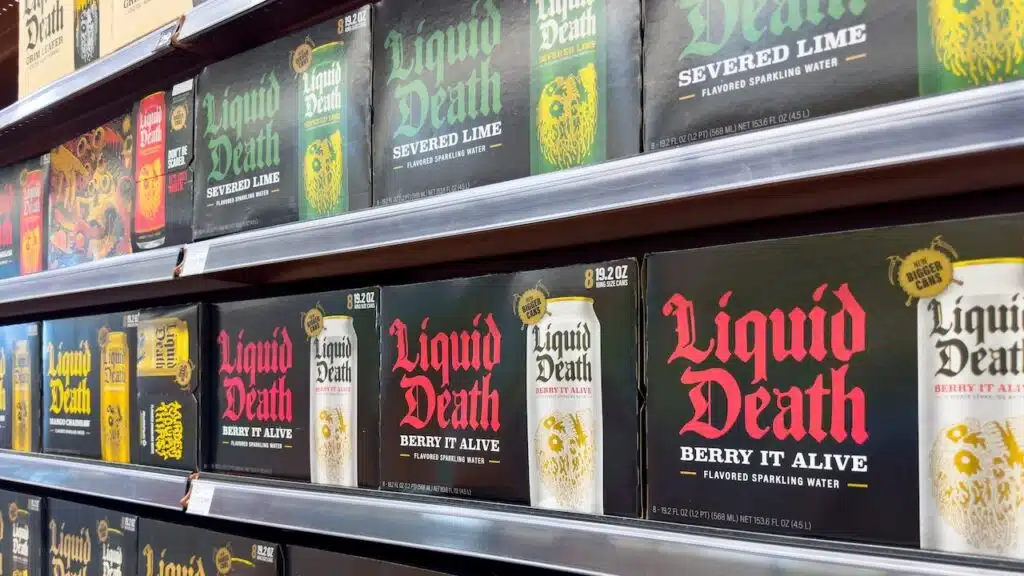
Liquid Death class action lawsuit overview:
- Who: Plaintiff James Williamson filed a class action lawsuit against Supplying Demand Inc., doing business as Liquid Death.
- Why: Williamson alleges Liquid Death’s “0g Sugar” sparkling energy drinks are sweetened with allulose, a sugar that contradicts the sugar-free claims on the label.
- Where: The Liquid Death class action lawsuit was filed in California federal court.
A new class action lawsuit alleges Liquid Death’s “0g Sugar” sparkling energy drinks are secretly sweetened with a sugar the company leaves off its front label.
Plaintiff James Williamson claims Liquid Death falsely advertises its sparkling energy drinks as “0g Sugar” and “Zero Sugar,” even though the products contain allulose, a monosaccharide sugar, as their second-most predominant ingredient behind carbonated water.
Williamson argues federal and California law cap “sugar free” claims at less than 0.5 grams of sugar per serving, a threshold the products exceed because allulose sits second on the ingredient list.
“0g Sugar Liquid Death sweetened predominantly with allulose is really just an energy drink sweetened with sugar; its very name is a lie,” the Liquid Death class action lawsuit states.
Williamson wants to represent a nationwide class of consumers who purchased the products in the United States, plus a California subclass of consumers.
Seventh Circuit’s Chobani ruling on allulose bolsters Liquid Death class action
The Liquid Death class action lawsuit leans on a Seventh Circuit ruling in July in Franco v. Chobani LLC, which found allulose qualifies as a sugar under the U.S. Food and Drug Administration’s (FDA) total-sugars regulation, reversing dismissal of similar claims against Chobani’s yogurt.
The FDA appeared as amicus curiae in that case and told the court the federal definition of total sugars includes every monosaccharide, including allulose, according to the complaint. Williamson argues the same reasoning applies to Liquid Death’s products.
The class action lawsuit also cites allulose’s manufacturer, Tate & Lyle, which has told the FDA that allulose “is a monosaccharide and is classified as a sugar,” noting that allulose.org, the sweetener industry’s own site, calls it a “low-calorie sugar.”
Surveys cited in the complaint found more than 70% of Americans try to limit sugar, though only 15% knew allulose is a sugar. Williamson alleges Liquid Death charges a premium, pointing to a 12-pack on Amazon for $21.99.
The complaint asserts violations of California’s Unfair Competition Law, False Advertising Law and Consumers Legal Remedies Act, along with breach of express warranty and unjust enrichment.
Williamson demands a jury trial and seeks class certification, injunctive relief, damages and restitution.
Currently, Unilever is facing similar accusations that its Liquid I.V. Hydration Multiplier electrolyte drink mix products contain allulose while advertised as “sugar-free,” “zero sugar” and “0 sugar.”
Have you ever purchased a Liquid Death “0g Sugar” sparkling energy drink? Let us know in the comments.
Williamson is represented by Valter Malkhasyan and Erik Pogosyan of Malk & Pogo Law Group LLP.
The Liquid Death class action lawsuit is Williamson v. Supplying Demand Inc., Case No. 4:26-cv-08839, in the U.S. District Court for the Northern District of California.

@topclassactions CONSUMER ALERT: Liquid Death faces a new class action lawsuit over claims its ?Zero Sugar? drinks contain allulose, a type of sugar. Have you purchased these drinks? Visit the link in our bio to learn more about these claims. #LiquidDeath #ClassAction #ConsumerAlert
♬ original sound – Top Class Actions – Top Class Actions
Don’t Miss Out!
Check out our list of Class Action Lawsuits and Class Action Settlements you may qualify to join!
Read About More Class Action Lawsuits & Class Action Settlements:

Real estate fees lawsuit: Did your agent or broker charge additional fees?
October 23, 2026 | Legal News





42 thoughts onLiquid Death class action claims ‘0g sugar’ drinks contain a known sugar, allulose
I’VE PURCHASED THIS A FEW TIMES SO PLEASE FOWARD ME THA’ NEEDED MATERIALS
Add me
Please Add Me Also
Please Add Me To The List
Add je please
Add me please.
I have many times.
add me
I buy those many times