

Judge Dismisses MacBook Retina Display Class Action Lawsuit
By Anne Bucher
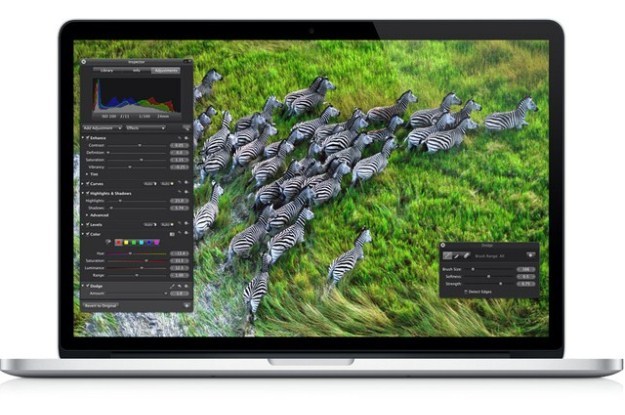 A California federal judge last week dismissed a class action lawsuit that accused Apple Inc. of tricking consumers into paying premium prices for MacBook Pro computers with sub-par LG Corp. retina display screens.
U.S. District Judge William H. Orrick found that plaintiff Beau Hodges failed to demonstrate exactly how Apple had deceived him. “Because, fundamentally, Hodges has not identified any affirmative misrepresentation made by Apple,” Judge Orrick granted Apple’s motion to dismiss the class action lawsuit on August 12, 2013. However, the judge offered Hodges 30 days to amend his complaint.
MacBook Pro laptops are made with retina displays made by either LG or Samsung Corp. Hodges filed his class action lawsuit in March, claiming that the LG screens are inferior to the Samsung screens and are prone to problems with brightness, color and lingering images. According to Hodges, consumers are unable to determine which manufacturer made the screen before they purchase the computer.
According to the MacBook retina display class action lawsuit, Apple “deliberately targeted its marketing effort at consumers who desire the absolute highest quality computer displays” and touted the MacBook Pro as having “the world’s highest-resolution notebook display.”
Judge Orrick took issue with Hodges’ class action lawsuit because he did not provide specific examples of how Apple had deceived him. Orrick determined that Hodges also failed to challenge any of the technical specifications that claim that the computers contain the highest resolution computer screens in the world.
Because Hodges’ claims refer to quality differences between screens manufactured by LG and Samsung, his class action lawsuit fails under the California Consumer Legal Remedies Act, which requires product failures to be linked to a safety concern. Judge Orrick also dismissed Hodges claims under California’s Unfair Competition Law and breach of contract claims. Hodges’ attorneys have indicated their intent to file an amended class action lawsuit.
Hodges purchased an Apple MacBook Pro with retina display in June 2012. Just one month later, he noticed that a shadow of an image that was previously displayed would occasionally linger on his computer screen. He alleges that the Samsung-manufactured screens “outperform” LG’s screens in brightness and accuracy of color. By filing the class action lawsuit, Hodges was seeking to recover unspecified damage for a nationwide class of consumers who purchased MacBook Pro laptops with LG-manufactured screens.
Although Apple knew about the differences between the two screens, Hodges claims, the company “publicly denied” them. He argues that no consumer would purchase the inferior product when offered a better product for the same price. In his class action lawsuit, Hodges accuses Apple of violating the California Consumer Legal Remedies Act, the California Unfair Competition Law and breach of contract.
Hodges is represented by Adam J. Levitt and Edmund S. Aronowitz of Grant & Eisenhofer PA and Joseph J. Siprut, Alexandra M.S. Vold, Gregg M. Barbakoff and Todd C. Atkins of Siprut PC.
The MacBook Retina Display Class Action Lawsuit is Hodges v. Apple Inc., case number 3:13-cv-01128, in the U.S. District Court for the Northern District of California.
All class action and lawsuit news updates are listed in the Lawsuit News section of Top Class Actions

Real estate fees lawsuit: Did your agent or broker charge additional fees?
October 23, 2026 | Legal News












4 thoughts onJudge Dismisses MacBook Retina Display Class Action Lawsuit
My 2012 MacBook Pro retina has this problem. Apple doesnt care.
I, too, have a MacBook Pro (Retina, 13-inch, Late 2012) with a screen “flicker” problem. I am not tech savvy enough to know whether I have the LG screen or the Samsung screen. I purchased the notebook certified refurbished. Clearly given the choice to buy a laptop with a screen that does not “flicker” versus a screen that does “flicker”, I would have purchased- at the same price- the laptop with a screen that does not “flicker”. All other things equal.
A laptop with a screen that does “flicker” is not the same as a laptop with a screen that does “flicker”, yet they were both sold under the same name as if they were the same thing. They are not!
I sure do hope that either some attorneys or some people with true legal prowess step forward and find the words to let Apple know that it is not profitable to sell two different things and pretend that they are the same thing. Cut and dry; they are not the same.
PS- Apple if you are watching, listening, something…….. you have a large and loyal customer base…… you have the power to make this right. The people that I professed the cult of Mac to, bought PCs after they saw the screen flicker and saw how little you as a company were doing to increase customer satisfaction. A happy customer is a repeat customer.
Thank you for listening
Although Hodges is correct. He seems to have chosen morons for counsel.
How can I put in my claim for my money back?