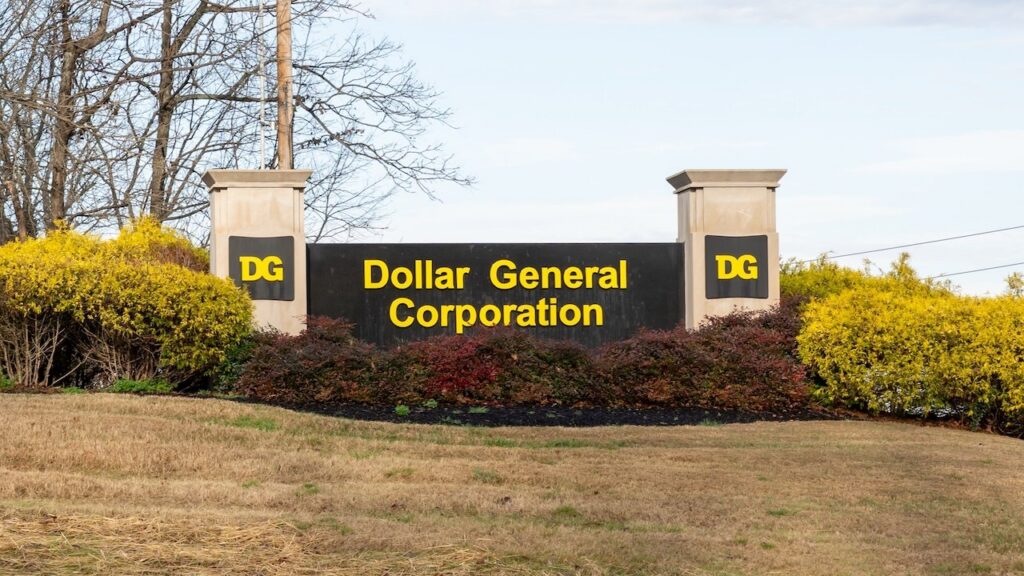
Dollar General lawsuit overview:
- Who: The Federal Trade Commission (FTC) and 20 states filed a lawsuit against Dollar General Corp., doing business as Dollar General.
- Why: The plaintiffs claimed Dollar General routinely charges shoppers more at the register than its advertised prices.
- Where: The Dollar General lawsuit was filed in Tennessee federal court.
Dollar General is facing a new lawsuit claiming it routinely charges customers more at the register than the prices displayed on shelves, price tags, circulars, its website and its app.
The Federal Trade Commission filed the case on Oct. 26 alongside 20 states, including California, Florida, Illinois and Ohio. The plaintiffs argue the chain markets itself to rural and low-income shoppers while routinely overcharging them.
According to the complaint, households earning $35,000 or less make up 60% of Dollar General’s revenue. As a result of the overcharges, the plaintiffs say “consumers nationwide have paid significantly more than they expected for basic household goods and necessities, enriching Dollar General at the expense of the low-income and rural households it markets itself as serving.”
Dollar General received at least 29,265 complaints categorized as “Did Not Honor Marked Price” between January 2023 and March 2026, the pricing lawsuit alleges.
As part of a multi-state investigation, FTC agents made undercover purchases in four states this year, and every purchase included items that rang up above the advertised price.
The complaint also highlights that since 2019, the retailer has entered into seven settlements with six states over inaccurate pricing, paying more than $6 million in penalties, and has faced eight class action lawsuits over pricing accuracy since 2022.
Earlier this year, Dollar General agreed to an $8.5 million class action settlement in New Jersey and additional settlements with an Ohio consumer and Ohio state.
Dollar General register prices change before shelf labels, lawsuit claims
The pricing lawsuit argues new prices take effect in Dollar General’s register system regardless of whether updated shelf labels have been posted. Because core price changes are “generally increases,” any lag usually means shoppers pay more.
Stores are supposed to schedule a weekly five-hour shift to replace labels, but many are too thinly staffed to keep up, the plaintiffs claim.
Dollar General told Law360 it aims for complete accuracy between shelf and register prices but that occasional discrepancies happen despite its policies. The company said it cooperated with the FTC investigation and will vigorously defend the case.
The Dollar General lawsuit asserts violations of the FTC Act, the Gramm-Leach-Bliley Act and state consumer protection laws. Under the Gramm-Leach-Bliley claim, the FTC argues Dollar General uses false price promises to obtain shoppers’ card and bank information at checkout.
The plaintiff and states seek a permanent injunction, monetary relief, civil penalties and restitution.
Have you been charged more at the register than the shelf price at Dollar General? Let us know in the comments.
The plaintiffs are represented by FTC attorneys Christopher J. Erickson, Baasil Shariff, Evan M. Mendelson and Maris K.V. Snell and attorneys representing each plaintiff state.
The Dollar General lawsuit is Federal Trade Commission, et al. v. Dollar General Corp., Case No. 3:26-cv-01693, in the U.S. District Court for the Middle District of Tennessee.
Don’t Miss Out!
Check out our list of Class Action Lawsuits and Class Action Settlements you may qualify to join!
Read About More Class Action Lawsuits & Class Action Settlements: