

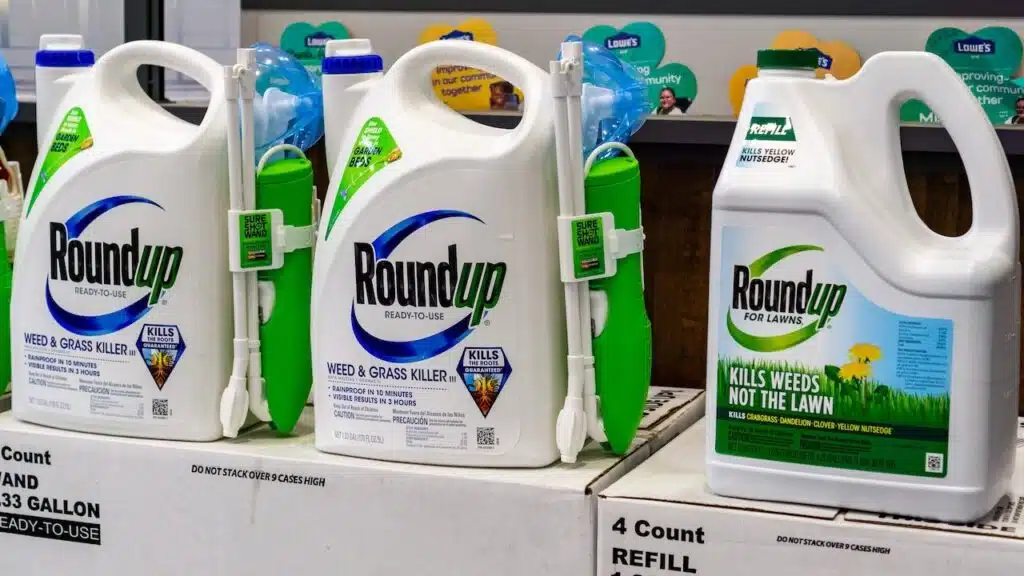
Roundup lawsuit overview:
- Who: A Massachusetts federal judge allowed a Roundup cancer lawsuit against Monsanto to proceed despite a recent U.S. Supreme Court ruling favoring the company.
- Why: The judge said the Supreme Court’s ruling may not eliminate other product liability and consumer protection claims asserted under Massachusetts law.
- Where: The lawsuit is pending in Massachusetts federal court.
- How to get help: Have you or a loved one been diagnosed with non-Hodgkin’s lymphoma or another cancer after using Roundup regularly? If so, you may qualify to join a Roundup cancer lawsuit.
A Massachusetts federal judge indicated a Roundup cancer lawsuit against Monsanto may still move toward trial despite a recent U.S. Supreme Court decision that significantly limited failure-to-warn claims involving the weedkiller.
During a recent hearing, U.S. District Judge Margaret Guzman said the Supreme Court’s decision in Durnell v. Monsanto does not necessarily end the lawsuit brought by plaintiffs Joel and Rachel Rubin.
Bayer said a June high court ruling that certain Roundup failure-to-warn claims were preempted by the Federal Insecticide, Fungicide and Rodenticide Act may significantly reduce the thousands of pending lawsuits.
Judge Guzman, however, said the Supreme Court’s ruling appeared to be limited to claims based on Roundup’s labeling.
“I believe that Durnell left open other state law claims, such as the other types of product defect and consumer claims that are not based on warning theories,” Judge Guzman said, as quoted by Law360. She also suggested plaintiffs may be able to pursue a failure-to-warn theory based on allegations that Monsanto could have provided warnings outside the product label.
The plaintiffs allege exposure to Roundup caused cancer and seek to hold Monsanto liable under Massachusetts law.
Monsanto opposes decision to allow plaintiffs to revise lawsuit
Judge Guzman gave the Rubins until Aug. 28 to amend their complaint to address the Supreme Court’s ruling and identify additional expert testimony before summary judgment proceedings resume.
Monsanto opposed allowing the amendment. According to the company’s counsel, plaintiffs should not be permitted to introduce an entirely new legal theory simply because the Supreme Court issued a ruling unfavorable to their original claims.
The judge emphasized that allowing the amendment does not guarantee the case will proceed to trial or succeed on the merits.
“This is an opportunity for the plaintiffs; it is not a foregone conclusion that it will be a successful amendment,” Judge Guzman said, as reported by Law360.
The court also ruled the plaintiffs cannot pursue punitive damages because Massachusetts law governs the case and does not permit such damages under the circumstances presented. Plaintiffs had argued Missouri law should apply, which could have allowed punitive damages.
The case remains scheduled for trial in early January 2026, although the judge noted it is uncertain whether the lawsuit ultimately will be decided by a jury.
The hearing comes as courts across the country continue evaluating the impact of the Supreme Court’s decision on thousands of pending Roundup lawsuits. Judge Guzman noted that several other Roundup cases remain pending in Massachusetts, while the state’s highest court is also considering related questions involving federal preemption.
Meanwhile, Bayer recently announced a proposed $7.25 billion settlement intended to resolve large numbers of future Roundup claims while continuing to maintain that Roundup does not cause cancer.
What do you think about the judge’s decision to allow the Roundup lawsuit another chance to proceed? Let us know in the comments.
The plaintiffs are represented by T. Matthew Leckman of Leckman Law LLC.
The Roundup lawsuit is Rubin, et al. v. Monsanto Co., Case No. 4:26-cv-40079, in the U.S. District Court for the District of Massachusetts.
Don’t Miss Out!
Check out our list of Class Action Lawsuits and Class Action Settlements you may qualify to join!
Read About More Class Action Lawsuits & Class Action Settlements:
- Dairy Queen recalls Galliker Dairy chocolate ice cream mix over metal shavings
- Five Below class action claims retailer kept tariff refunds owed to customers
- Lowe’s class action alleges recalled Kobalt yard tools have dangerous battery defect
- Coachella class action claims music festival website illegally tracks visitors

Real estate fees lawsuit: Did your agent or broker charge additional fees?
October 23, 2026 | Legal News









3 thoughts onRoundup cancer lawsuit may proceed despite Supreme Court ruling
add me
Add me
Add me