

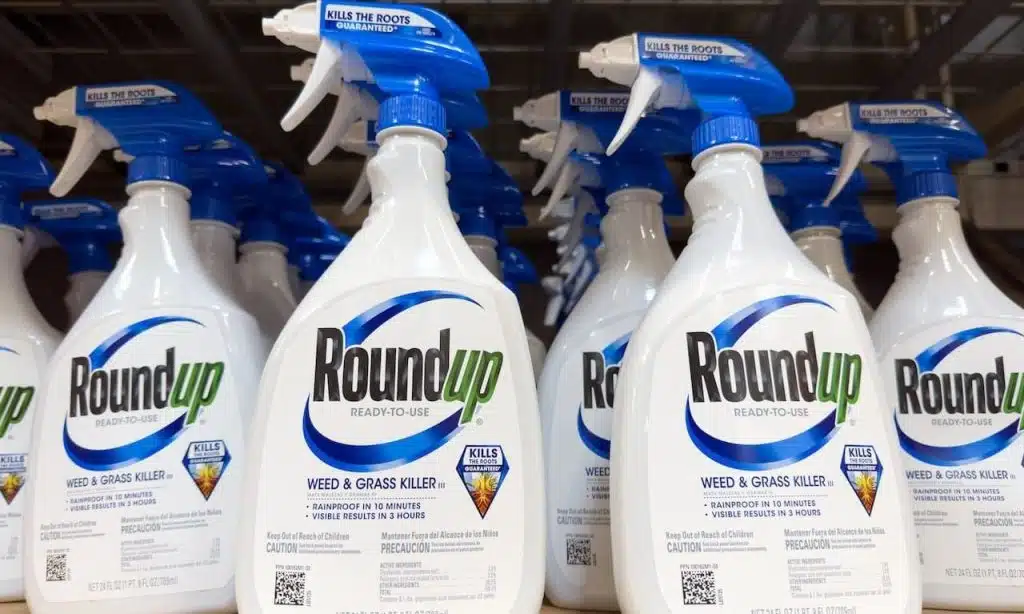
Supreme Court Roundup ruling overview:
- Who: The U.S. Supreme Court ruled in favor of Monsanto Company, a Bayer AG subsidiary, in a decision affecting thousands of pending Roundup cancer lawsuits.
- Why: The justices held that federal pesticide law preempts state failure-to-warn claims, reversing a jury verdict won by plaintiff John Durnell over Roundup’s lack of a cancer warning.
- Where: The Monsanto decision came from the U.S. Supreme Court on appeal from Missouri state court.
- How to get help: Have you or a loved one been diagnosed with non-Hodgkin’s lymphoma or another form of cancer after using Roundup regularly? If so, you may qualify to take legal action.
The U.S. Supreme Court ruled 7-2 on June 25 that federal pesticide law blocks state lawsuits claiming Roundup weed killer causes cancer, affecting Monsanto and its parent company, Bayer.
According to the Roundup lawsuit, Missouri gardener John Durnell sued Monsanto in 2019 after using Roundup for about 20 years and developing non-Hodgkin lymphoma. Durnell argued Monsanto should have added a cancer warning to Roundup’s label. A jury awarded him $1.25 million, and the Missouri Court of Appeals upheld the verdict.
Writing for the majority, Justice Brett Kavanaugh found that the preemption clause, titled “Uniformity,” under the Federal Insecticide, Fungicide and Rodenticide Act bars states from imposing labeling requirements that the U.S. Environmental Protection Agency (EPA) has not required.
Since the EPA has repeatedly approved Roundup’s label without a cancer warning, Durnell’s claim sought a change federal law does not allow, since “Uniformity” in labeling would otherwise be impossible to achieve, he wrote.
The court leaned on its 2008 Riegel v. Medtronic decision, which found federal device approval could similarly preempt state tort claims.
Justice Ketanji Brown Jackson dissented, joined by Justice Neil Gorsuch, arguing the ruling unjustifiably closes the courthouse doors to state tort plaintiffs.
Law360 reported that Jackson called the outcome “both remarkable and regrettable” amid a lineup that saw liberal Justices Elena Kagan and Sonia Sotomayor join the majority while Gorsuch broke ranks.
$7.25 billion Roundup settlement remains on track despite Supreme Court loss
The Supreme Court ruling does not end Roundup lawsuit litigation. Reuters reports Bayer faces claims from roughly 65,000 plaintiffs, most also raising negligence, misrepresentation and defect claims that survive even though failure-to-warn claims do not.
Separately, Bayer reached a proposed $7.25 billion settlement in February 2026, with attorneys representing people who say Roundup caused their cancer. The deal covers pending claims and future cases from people already exposed who later develop cancer.
A Missouri judge granted initial approval in March 2026, though some have objected, and final approval remains pending.
Bayer said the ruling does not change the settlement’s terms. People in the settlement had until June 4, 2026, to opt out and sue individually, a choice made before knowing how the Court would rule.
Settlement attorneys told Reuters the ruling validates locking in compensation early, meaning claimants who stayed in can still collect a payout despite losing the failure-to-warn option.
What do you think about the Monsanto decision in this Roundup lawsuit? Let us know in the comments.
Durnell is represented by Ashley Keller of Keller Postman LLC. Monsanto is represented by Paul Clement of Clement & Murphy PLLC.
The Supreme Court Roundup ruling is Monsanto Co. v. Durnell, Case No. 24-1068, on certiorari to the Court of Appeals of Missouri, Eastern District.
Don’t Miss Out!
Check out our list of Class Action Lawsuits and Class Action Settlements you may qualify to join!
Read About More Class Action Lawsuits & Class Action Settlements:












7 thoughts onSupreme Court limits Roundup lawsuits as Bayer settlement continues
a major California investigation published in the BMJ, look at mothers who lived within 2,000 meters of agricultural fields. These studies found a modest, statistically significant increase (around 16% to 30%) in autism risk for children whose mothers lived near heavy, ambient pesticide spraying during pregnancy.
Initially started in his bladder and he got that removed, and then it had spread to his colon*****
My dad recently passed last November due to a stage for cancer diagnose 2023 initially started in bladder and got the moon been spread to his colon in a few other places, but the one in his colon was mastasized and ended up rupturing , causing him to go septic and us to have to say our goodbyes. But as a good father, does he literally tried every day for the remainder of his days to prepare me for the future as best as he could anyways, I remember him telling me he filled out some paperwork for the round up thing because of how often he used it. he had gotten something back from one of the attorneys asking for more information but seeing how my dad passed I don’t know what information would be needed or if I would even know it please let me know please. Thank you.
Add me
Add me
Add Me been using this for many years
add me