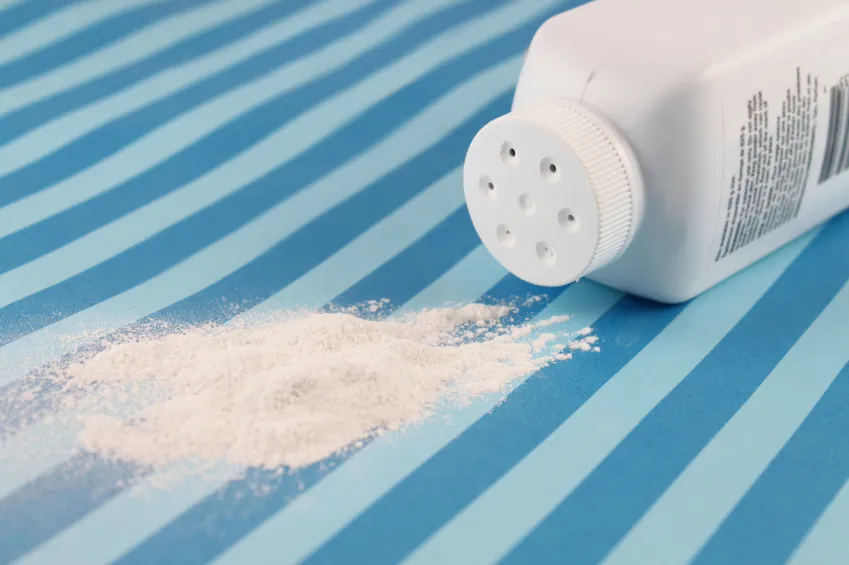
 Baby powder seems like a relatively innocuous product, especially considering that it is ostensibly designed for use with the most vulnerable population of humans: infants. However, recent studies have found evidence that certain types of baby powder may cause serious health problems. This has resulted in baby powder class action lawsuits.
There are two main types of baby powder: one made of talc and one made of cornstarch. The cornstarch variety is generally recognized as safe. However, the variety of baby powder derived from talc has been linked to health problems.
Talc is a naturally-occurring mineral. More specifically, it belongs to the silicate family, a group of minerals that includes asbestos. In fact, older formulations of talcum powder sometimes included asbestos as a contaminant. New laws in the early 1970s made certain that manufacturers stop using asbestos-contaminated talc for baby powder. However, talc powder itself may have some serious side effects.
Since the 1970s, talc itself has been linked to an increased risk of ovarian cancer. During this time, studies indicated that more than three-quarters of ovarian tumors had talc embedded within them. However, this type of study was not a “lock” on the subject. Researchers were careful to point out that this did not confirm the mineral could cause cancer. It was unknown how widespread talc was in ovarian tissue, making it difficult to prove the link. However it set the stage for future research.Research on the alleged link between talc and ovarian cancer has continued.
In 2003, the peer-reviewed journal Anticancer Research published a meta-analysis by M. Huncharek and others. A meta-analysis is a type of research paper where researchers evaluate and compare previous studies on a given subject and compare their results. The Huncharek paper, for example, compared the results of 16 older studies in order to evaluate the safety of talc. The study found that women who used talc powder on their genitals experienced a 30 percent increase in their risk of developing ovarian cancer. This means that since the average woman has a lifetime risk of 1.4 percent for contracting ovarian cancer, a woman who uses talc-based baby powder has a 1.8 percent risk. While this might not sound like a large change, it could means millions of new potential cases of ovarian cancer, a life-threatening disease.
Litigation over talc-based baby powder may take the form of a baby powder class action lawsuit. Class action lawsuits are a type of group lawsuit. Group lawsuits are designed to help streamline the legal process by combining dozens, hundreds, or even thousands of potential individual lawsuits into a single class action lawsuit. In a class action lawsuit, a group of plaintiffs allege that they have suffered similar harm at the hands of the same defendants.
In general, baby powder cancer lawsuits are filed individually by each plaintiff and are not class actions.
Do YOU have a legal claim? Fill out the form on this page now for a free, immediate, and confidential case evaluation. The attorneys who work with Top Class Actions will contact you if you qualify to let you know if an individual lawsuit or class action lawsuit is best for you. Hurry — statutes of limitations may apply.
ATTORNEY ADVERTISING
Top Class Actions is a Proud Member of the American Bar Association
LEGAL INFORMATION IS NOT LEGAL ADVICE
Top Class Actions Legal Statement
©2008 – 2026 Top Class Actions® LLC
Various Trademarks held by their respective owners
This website is not intended for viewing or usage by European Union citizens.
Get Help – It’s Free
Join a Free Baby Powder Cancer Class Action Lawsuit Investigation
If you used Johnson’s Baby Powder, Shower to Shower, or another talcum powder product and were diagnosed with ovarian cancer, you may have a legal claim. Family members of loved ones who died of ovarian cancer can also join. Submit your information now for a free case evaluation.
An attorney will contact you if you qualify to discuss the details of your potential case at no charge to you.