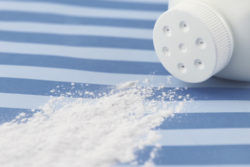
 Plaintiff Candace M. has filed a new lawsuit alleging that talcum powder exposure from Johnson & Johnson caused serious baby powder injuries, including the development of ovarian cancer.
Candace, a resident and citizen of New Haven County, Conn., alleges she began using Johnson & Johnson baby powder as part of a personal hygiene routine in 1976 and kept using it until 2015.
It was in March 2013 that she was diagnosed with ovarian cancer, the talcum powder exposure lawsuit says.
Her lawsuit was filed on Nov. 21, 2017, in the U.S. District Court for the District of Connecticut. According to the talcum powder exposure lawsuit, Candace developed ovarian cancer as a direct result of using Johnson & Johnson’s baby powder.
The talcum powder exposure lawsuit was filed on multiple counts, including violation of the Product Liability Act, violation of the Connecticut Unfair Trade Practices Act, Concert of Action, and Civil Conspiracy.
Ovarian Cancer Key Statistics
According to the American Cancer Society, roughly 22,440 women in the United States will receive an ovarian cancer diagnosis in 2017. About 14,080 women will have died from ovarian cancer in the same year.
A woman’s risk in developing ovarian cancer is about 1 in 75 during her lifetime, and the risk of her dying from ovarian cancer is about 1 in 100.
The Cancer Society ranks ovarian cancer as fifth in the leading cause of death in women dying from cancer. It is also a cancer that mainly develops in older women who are 63 years or older.
Overview: Johnson & Johnson Talcum Powder Exposure
There are roughly 5,000 pending lawsuits against Johnson & Johnson in federal and state court alleging that the talcum particles in the company’s baby powder caused their ovarian cancer.
Talc is a naturally occurring mineral and is found to be one of the softest minerals on earth. Talc, when finely ground, reduces friction and absorbs odor, oils, and moisture.
In its unrefined form, talc can contain asbestos. The International Agency for Research on Cancer (IARC), part of World Health Organization (WHO), had classified talc that contains asbestos as “carcinogenic to humans.”
The U.S. Food and Drug Administration (FDA) also said that it is unacceptable for talc, used for cosmetic purposes, to contain asbestos. Talc without asbestos is also classified as “possibly carcinogenic to humans” by the IARC, and since 1973 federal laws have required that talc products sold in the U.S. must be asbestos free.
Allegations against Johnson & Johnson assert that the company failed to warn consumers about cancer risks that can develop from use of the talc-based products. Plaintiffs further purport that Johnson & Johnson and the company’s talc supplier, Imerys Talc America, knew about the cancer-causing material but continued to sell the products without warning.
The Talcum Powder Exposure Lawsuit is Case No. 3:17-cv-01963, in the U.S. District Court for the District of Connecticut.
Do YOU have a legal claim? Fill out the form on this page now for a free, immediate, and confidential case evaluation. The attorneys who work with Top Class Actions will contact you if you qualify to let you know if an individual lawsuit or class action lawsuit is best for you. [In general, baby powder cancer lawsuits are filed individually by each plaintiff and are not class actions.] Hurry — statutes of limitations may apply.
ATTORNEY ADVERTISING
Top Class Actions is a Proud Member of the American Bar Association
LEGAL INFORMATION IS NOT LEGAL ADVICE
Top Class Actions Legal Statement
©2008 – 2026 Top Class Actions® LLC
Various Trademarks held by their respective owners
This website is not intended for viewing or usage by European Union citizens.
Get Help – It’s Free
Join a Free Baby Powder Cancer Class Action Lawsuit Investigation
If you used Johnson’s Baby Powder, Shower to Shower, or another talcum powder product and were diagnosed with ovarian cancer, you may have a legal claim. Family members of loved ones who died of ovarian cancer can also join. Submit your information now for a free case evaluation.
An attorney will contact you if you qualify to discuss the details of your potential case at no charge to you.
Please Note: If you want to participate in this investigation, it is imperative that you reply to the law firm if they call or email you. Failing to do so may result in you not getting signed up as a client, if you qualify, or getting you dropped as a client.