

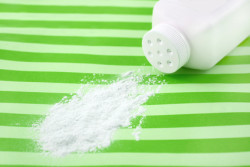
 Johnson & Johnson is facing a new talcum powder lawsuit, alleging that the company’s talc based baby powder and Shower-to-Shower powder had caused her to develop ovarian cancer.
This proposed class action was recently filed in Louisiana federal court, days after a New Jersey state judge had dismissed two earlier class actions also alleging baby powder ovarian cancer.
Plaintiff Shintelle Joseph joins the many consumers alleging Johnson & Johnson’s talcum powder products can induce ovarian cancer, when the company advertised them to be safe.
Oftentimes consumers use talcum powder for a variety of hygienic purposes, with women often implementing the powder to their genital area to reduce odor and moisture.
Joseph’s lawsuit states that the company either knew or should have known the risk of baby powder ovarian cancer, and that consumers rely on the marketing claims made by Johnson & Johnson.
Similar talcum powder lawsuits have yielded different results in the litigation process, with two lawsuits recently dismissed while another had reached victory.
Overview of Baby Powder Ovarian Cancer Litigation
Recently a Missouri state jury had awarded a plaintiff $55 million, after she allegedly developed baby powder ovarian cancer in alleged result of applying the talc powder to her genital area.
This came as a second major defeat for Johnson & Johnson, after a jury handed down a $72 million award in a similar case.
However a number of talcum powder cancer lawsuits have not been so lucky, as Atlantic County Judge Nelson C. Johnson dismissed a pair of talcum powder cancer lawsuits.
Judge Johnson stated that the women’s expert witnesses did not produce sufficient scientific evidence showing a link between talcum powder and ovarian cancer.
One of these expert witnesses was Dr. Daniel Cramer, who was involved in the first epidemiological inquiry conducted to observe talcum powder being used on the female genital area.
The study was conducted in 1982, and found a 92% increased risk of ovarian cancer in women using talcum powder for feminine hygiene.
After this study, it was recommended that Johnson & Johnson update their talc powder products to include the risk of ovarian cancer.
There have been 22 studies conducted to observe the alleged risk of baby powder ovarian cancer since, all of which show an increased risk of ovarian cancer after using talcum powder.
Joseph states that she began applying Johnson & Johnson’s talcum powder products to her genital area when she was 17 years old, and had continued to do so for over a decade before she was diagnosed with ovarian cancer.
She is bringing forward multiple counts of negligence, and failure to warn against the risk of baby powder ovarian cancer.
The Baby Powder Ovarian Cancer Class Action Lawsuit is Shintelle Joseph v. Johnson & Johnson et al., Case No. 3:16-cv-00590, in the U.S. District Court for the Middle District of Louisiana.
Do YOU have a legal claim? Fill out the form on this page now for a free, immediate, and confidential case evaluation. The attorneys who work with Top Class Actions will contact you if you qualify to let you know if an individual lawsuit or class action lawsuit is best for you. [In general, baby powder cancer lawsuits are filed individually by each plaintiff and are not class actions.] Hurry — statutes of limitations may apply.
ATTORNEY ADVERTISING
Top Class Actions is a Proud Member of the American Bar Association
LEGAL INFORMATION IS NOT LEGAL ADVICE
Top Class Actions Legal Statement
©2008 – 2026 Top Class Actions® LLC
Various Trademarks held by their respective owners
This website is not intended for viewing or usage by European Union citizens.
Get Help – It’s Free
Join a Free Baby Powder Cancer Class Action Lawsuit Investigation
If you used Johnson’s Baby Powder, Shower to Shower, or another talcum powder product and were diagnosed with ovarian cancer, you may have a legal claim. Family members of loved ones who died of ovarian cancer can also join. Submit your information now for a free case evaluation.
An attorney will contact you if you qualify to discuss the details of your potential case at no charge to you.
Please Note: If you want to participate in this investigation, it is imperative that you reply to the law firm if they call or email you. Failing to do so may result in you not getting signed up as a client, if you qualify, or getting you dropped as a client.











