

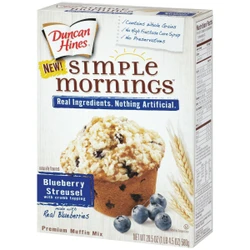
 The makers of a Duncan Hines muffin mix will continue to face a false advertising class action lawsuit following a federal judge’s denial of their motion to dismiss the claim.
U.S. District Judge John A. Ross rejected all arguments raised by defendant Pinnacle Foods Group LLC in moving for dismissal of the Duncan Hines class action lawsuit.
The judge found that while questions of fact may require resolution later in the litigation, plaintiff Erika Thornton has adequately raised allegations of false advertising.
Thornton filed this Duncan Hines class action lawsuit in January 2016, accusing Pinnacle of falsely labeling its Duncan Hines Simple Mornings Blueberry Streusel Premium Muffin Mix.
The label for that mix allegedly describes it as containing “Nothing Artificial,” but Thornton says the mix contains monocalcium phosphate and xanthan gum, which she says are “artificial, synthetic substances.”
She says the “Nothing Artificial” representation on the label is therefore “false, deceptive, and misleading.”
In moving for dismissal, Pinnacle argued that Thornton fails to offer a definition of “artificial” that applies to monocalcium phosphate and xanthan gum.
Judge Ross found such a definition is unnecessary at the pleading stage. He said that Thornton’s pleadings allege all the facts necessary to establish a claim for false or deceptive representation.
Pinnacle also argued that the Duncan Hines label could not be deceptive because it discloses monocalcium phosphate and xanthan gum in the ingredient list on the back of the box.
Judge Ross disagreed. He found that Thornton’s pleadings raise the possibility that a consumer might rely on the “Nothing Artificial” representation without checking the ingredient list, or that the consumer might not know that monocalcium phosphate or xanthan gum are “artificial.”
These allegations raised in Thornton’s pleadings bring up questions of fact that cannot be resolved on a motion to dismiss, Judge Ross said.
Judge Ross also rejected Pinnacle’s argument that Thornton’s allegations of damages are not specific enough.
Thornton claims her own damages are the “difference between the actual value of the product and the value of the product if it had been as represented.”
Judge Ross determined these allegations were enough to state a claim for damages and that specifics are not necessary at this stage.
Thornton’s Duncan Hines class action lawsuit raises claims for violation of Missouri’s Merchandising Practices Act, which generally makes unlawful any deceptive or false representation made in the connection with the advertisement or sale of any merchandise.
The plaintiff is also bringing a claim for unjust enrichment.
Thornton proposes to represent a plaintiff Class consisting of “[a]ll persons in Missouri who purchased Duncan Hines Simple Mornings Blueberry Streusel Premium Muffin Mix for personal, household, or family purposes” during the five years preceding the filing of her Duncan Hines class action lawsuit.
She is asking the court to award her and the proposed Class compensatory damages or alternatively to require Pinnacle to disgorge profits resulting from the alleged deceptive advertising.
Plaintiff’s counsel are attorneys Matthew H. Armstrong of Armstrong Law Firm LLC and Stuart L. Cochran of Cochran Law PLLC.
The Duncan Hines False Advertising Class Action Lawsuit is Erika Thornton v. Pinnacle Foods Group LLC, Case No. 4:16-cv-00158, in the U.S. District Court for the Eastern District of Missouri.
ATTORNEY ADVERTISING
Top Class Actions is a Proud Member of the American Bar Association
LEGAL INFORMATION IS NOT LEGAL ADVICE
Top Class Actions Legal Statement
©2008 – 2026 Top Class Actions® LLC
Various Trademarks held by their respective owners
This website is not intended for viewing or usage by European Union citizens.














One thought on Duncan Hines ‘Nothing Artificial’ Class Action Survives Dismissal
Two years pass and this case is still weak?