

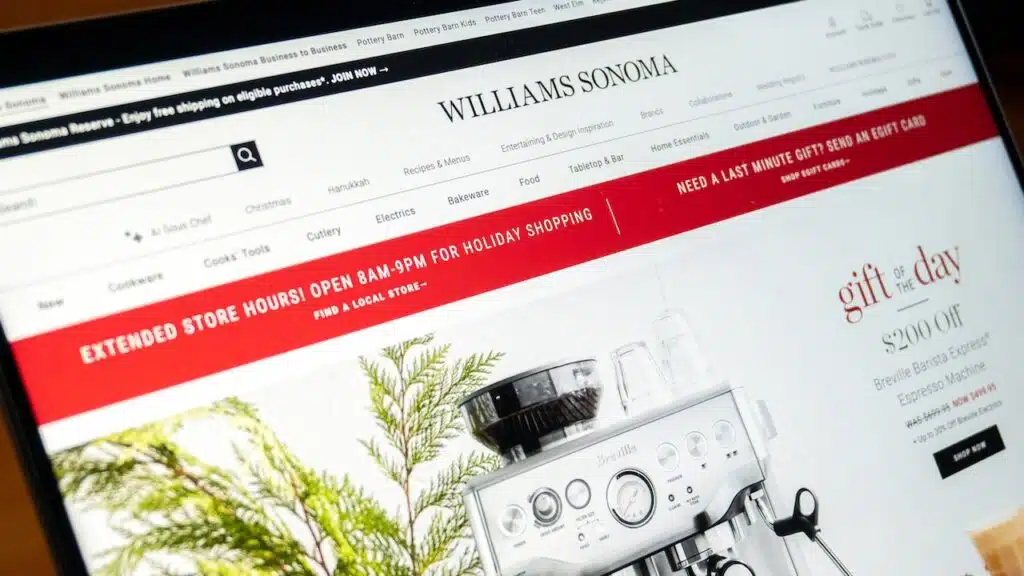
Williams-Sonoma class action overview:
- Who: Plaintiffs Katie O’Malley and Megan Reilly filed a class action lawsuit against Williams-Sonoma Inc.
- Why: O’Malley and Reilly claim Williams-Sonoma unlawfully charges consumers a hidden processing fee when making purchases on its websites.
- Where: The class action lawsuit was filed in California federal court.
A new class action lawsuit accuses Williams-Sonoma of unlawfully charging consumers a hidden processing fee when they make purchases on its websites.
Plaintiffs Katie O’Malley and Megan Reilly claim Williams-Sonoma quotes prices on selected items that are “artificially low” before “sneaking in” a mandatory “processing” fee after consumers input their shipping and credit card information.
“This cheap trick has enabled [Williams-Sonoma] to swindle substantial sums of money from its customers,” the Williams-Sonoma class action lawsuit says.
O’Malley and Reilly want to represent a nationwide class of consumers who paid a “shipping & processing” fee when purchasing items on Williams-Sonoma’s websites since Feb. 11, 2023.
The plaintiffs also want to represent a California and Virginia class of consumers who paid a “shipping & processing” fee when purchasing items on Williams-Sonoma’s websites since Feb. 11, 2023, and Feb. 11, 2024, respectively.
Williams-Sonoma engages in ‘drip pricing,’ class action claims
O’Malley and Reilly claim the alleged hidden processing fee charged by Williams-Sonoma is an example of what is known as “drip pricing,” a practice they argue “has long violated various state laws.”
“In recent years, given the proliferation of drip pricing on online ecommerce platforms, various states, including California and Virginia, began passing laws specifically prohibiting drip pricing,” the Williams-Sonoma class action lawsuit says.
O’Malley and Reilly argue Williams-Sonoma is guilty of violating California’s Honest Pricing Law and Virginia’s Mandatory Fee and Surcharge Disclosure Law.
The plaintiffs demand a jury trial and request declaratory and injunctive relief and an award of compensatory and statutory damages for themselves and all class members.
In other recent news involving Williams-Sonoma, a California federal judge denied the company’s request to narrow a certified class in a lawsuit arguing it misled customers about the thread count of its bedding products.
Have you paid a processing fee when purchasing an item on Williams-Sonoma’s website? Let us know in the comments.
The plaintiffs are represented by Stefan Bogdanovich of Bursor & Fisher P.A.
The Williams-Sonoma class action lawsuit is O’Malley, et al. v. Williams-Sonoma Inc., Case No. 3:26-cv-01276, in the U.S. District Court for the Northern District of California.
Don’t Miss Out!
Check out our list of Class Action Lawsuits and Class Action Settlements you may qualify to join!
Read About More Class Action Lawsuits & Class Action Settlements:
- Breckenridge recalls Duloxetine delayed-release capsules due to carcinogen risk
- DentaQuest data breach class action filed over ShinyHunters cyberattack
- Evereden class action alleges auto-renewal subscriptions violate California law
- Unisom sued over allegedly misleading ‘non-habit forming’ sleep aid claims











One thought on Consumers sue Williams-Sonoma over alleged hidden ‘shipping & processing’ fees
I purchased an apron for $29 – the shipping and handling – which was not itemized – or shown to me – until the order was processed. The fees for a $29 apron were $11 – almost 1/2 the price of the item. How much does it cost to ‘throw it in a plastic bag’ and slap a label on it?