

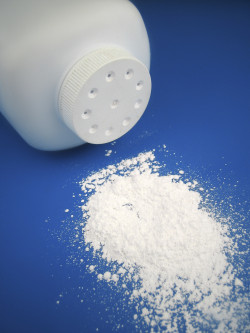
 Following the recent verdicts against Johnson & Johnson in baby powder cancer trials, more women are becoming aware of the risks associated with talc powder use and its link to ovarian cancer.
Last month, a St. Louis jury ordered Johnson & Johnson to pay $55 million to a plaintiff who alleged the company’s talc powder caused her to develop ovarian cancer.
In February, Johnson & Johnson was ordered to pay $72 million to the family of a plaintiff who died of baby powder cancer.
Both women who were plaintiffs in the recent verdicts were African-American, and according to an article in the Atlanta Black Star, African-American women are more likely than their Caucasian counterparts to use baby powder as part of their personal hygiene regimen.
The article cites a study conducted by epidemiologist Joellen Schildkraut at the University of Virginia in Charlottesville who found that women who used talc powder in their genital areas had more than a 40 percent risk of developing baby powder cancer and those who used the talcum powder in other areas of the body had over a 30 percent risk.
The epidemiologist and her team spoke to over 1,300 African-American women to determine their talc powder use. She found that of the 584 women who were diagnosed with ovarian cancer, 63 percent used talc powder.
Of the 745 African-American women who did not have ovarian cancer, nearly 53 percent used talc powder.
The article quotes Schildkraut as saying, “I was a cynic until these recent studies came out. As you look across all these studies, I would say, why use it? It’s an avoidable risk for ovarian cancer.”
Atlanta Black Star also reported that “Schildkraut acknowledges baby powder sellers target Black women who use talcum powder ‘more commonly.’”
The article cited a case-control study carried out in Los Angeles last year that concluded 44 percent of black women used talcum powder as compared to white women.
According to the article, “Atlanta Black Star reports New Jersey-based Johnson & Johnson knew about the link between the substance and ovarian cancer and marketed it to black women when white women stopped buying.”
Baby Powder Cancer Concerns
Johnson’s Baby Powder and many other brands of baby powder use talc as the base of the baby powder. Talc is a naturally occurring mineral that is mined in a way similar to asbestos.
Other baby powder brands, especially many health-conscious brands at specialty health food stores and in natural baby boutiques, use other powders as the base of the product, such as cornstarch or arrowroot powder. The baby powder cancer concerns are only related to talc-based powders.
Scientists have suspected a link between talc powder and ovarian cancer for decades. One study looked at ovarian cysts extracted from women and found talc embedded in all of them.
Other studies have reported that women who use talc-based baby powder in the genital area have a 40 percent higher risk of developing ovarian cancer as compared to those who do not use the product.
Not all studies, however, have confirmed a link, and until there is a definitive warning for women to refrain from using talc powder in the genital area, women will have to decide on their own if the baby powder cancer risk is one they are willing to take by using talc powder products.
Do YOU have a legal claim? Fill out the form on this page now for a free, immediate, and confidential case evaluation. The attorneys who work with Top Class Actions will contact you if you qualify to let you know if an individual lawsuit or class action lawsuit is best for you. [In general, baby powder cancer lawsuits are filed individually by each plaintiff and are not class actions.] Hurry — statutes of limitations may apply.
ATTORNEY ADVERTISING
Top Class Actions is a Proud Member of the American Bar Association
LEGAL INFORMATION IS NOT LEGAL ADVICE
Top Class Actions Legal Statement
©2008 – 2026 Top Class Actions® LLC
Various Trademarks held by their respective owners
This website is not intended for viewing or usage by European Union citizens.
Get Help – It’s Free
Join a Free Baby Powder Cancer Class Action Lawsuit Investigation
If you used Johnson’s Baby Powder, Shower to Shower, or another talcum powder product and were diagnosed with ovarian cancer, you may have a legal claim. Family members of loved ones who died of ovarian cancer can also join. Submit your information now for a free case evaluation.
An attorney will contact you if you qualify to discuss the details of your potential case at no charge to you.
Please Note: If you want to participate in this investigation, it is imperative that you reply to the law firm if they call or email you. Failing to do so may result in you not getting signed up as a client, if you qualify, or getting you dropped as a client.











