
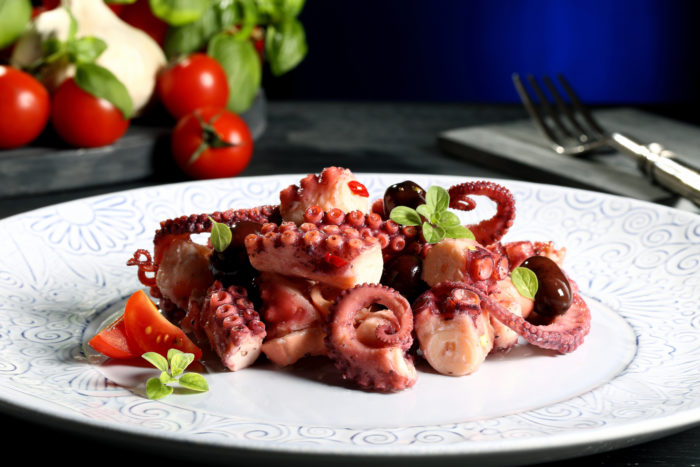
 A class action lawsuit claims that Roland Food’s canned octopus is really made of giant squid, a cheaper and less sought-after seafood.
Plaintiff Luis Diego Zapata Fonseca alleges that Roland Food knew or should have known that their octopus products did not contain octopus at all, and intentionally misled customers into believing that they were receiving a higher-quality product.
The Roland false advertising class action lawsuit says that Roland Food is a brand that sells a range of packaged foods, including batter mixes, snacks, condiments, cereals, and other foods. Allegedly, these products are sold both at large and small retailers.
According to Fonseca, Roland gets its seafood from Orbe, a large seafood supplier and cannery. Allegedly, Orbe and Roland both pass squid off as being octopus when selling it to consumers.
The Roland octopus class action says that the product is mislabeled because nowhere on the label is it advertised that the product contains squid instead of, or along with octopus.
Fonseca also argues that he and other consumers who purchase Roland Food’s octopus are economically injured by the alleged deception, because they are receiving a lower-quality product than they paid for.
Allegedly, octopus is more expensive and more sought-after than squid. According to the Roland octopus class action, octopus is considered a delicacy, but squid is considered less of a delicacy.
The Roland Food class action lawsuit argues that the company uses the fact that octopus and squid look similar to pass one off as the other.
However, the squid allegedly must undergo a chemical treatment to make the texture more similar to octopus texture. Additionally, the process reportedly eliminates a flavor characteristic to giant squid but not present in octopus.
Fonseca notes that octopus prices have risen dramatically in recent years. As a result of overfishing, octopus populations have dwindled, to the point that the European Union has imposed new restrictions on octopus fishing.
However, the Roland octopus class action lawsuit goes on to note that squid populations are thriving, because they are able to “adapt to changing ocean conditions caused by global warming.”
Allegedly, the scarcity of octopus and the availability of squid makes octopus much more valuable to consumers. Additionally, consumers are willing to pay higher prices for octopus than they are for squid.
Fonseca claims that Roland Food took advantage of consumers’ willingness to pay high prices for octopus and unlawfully enriched itself by charging a high price but giving consumers a lower-quality product, thereby increasing their profit margin.
The Roland octopus class action claims that most consumers would not be able to tell the difference between octopus and squid tentacles, especially because they are sold in pieces, and even more so when the seafood is sold in sauce, as is the case in many of Roland Food’s products.
Fonseca is represented by Kim E. Richman of Richman Law Group, James P. Gitkin of Salpeter Gitkin LLP, and by Joshua H. Eggnatz of Eggnatz | Pascucci.
The Roland Food Octopus Class Action Lawsuit is Luis Diego Zapata Fonseca v. Roland Food LLC, et al., Case No. 1:18-cv-10259-PAC, in the U.S. District Court for the Southern District of New York.
ATTORNEY ADVERTISING
Top Class Actions is a Proud Member of the American Bar Association
LEGAL INFORMATION IS NOT LEGAL ADVICE
Top Class Actions Legal Statement
©2008 – 2026 Top Class Actions® LLC
Various Trademarks held by their respective owners
This website is not intended for viewing or usage by European Union citizens.














2 thoughts onRoland Food’s Octopus is Really Giant Squid, Class Action Claims
Please add me.
Some thing fishy about this. It tasted wierd