
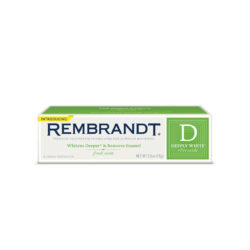
 A class action lawsuit claims Rembrandt Deeply White tooth whitening products can’t possibly live up to the promises made on their labeling.
Plaintiffs Melanie Barber and Ki Burke of California and Joseph Gregorio of New York say that Rembrandt Deeply White + Peroxide toothpaste and mouthwash is falsely advertised as being able to whiten teeth beneath their outer surface.
In fact, the plaintiffs say the amount of peroxide in the subject products isn’t enough to get past the outer layer of tooth enamel.
Nor does the peroxide spend enough time in contact with teeth during normal brushing or rinsing to affect the teeth below their outer surface, they claim.
The plaintiffs point to specific representations on the label for Rembrandt Deeply White + Peroxide toothpaste that say the product “safely whitens below the enamel to help remove deep stains where they start.”
According to representations on its label, Rembrandt Deeply White toothpaste “[g]oes beyond surface stain whitening, to a radiant smile that shines from the inside and out.” The packaging for the mouthwash makes a similar representation, according to plaintiffs.
Plaintiffs also show an image from the defendants’ website that purports to illustrate how the peroxide from Rembrandt Deeply White products penetrates a tooth’s outer layer of enamel and reaches all the way to its dentin layer.
These representations can’t possibly be true, according to the Rembrandt Deeply White class action lawsuit. Plaintiffs say clinical studies have shown that for peroxide to penetrate into teeth, it must be applied for several hours per week and at much higher concentrations than are present in the disputed products.
Plaintiffs also say effective penetration can’t happen without holding the peroxide directly against the tooth, ideally using something like a custom-made whitening tray.
All three plaintiffs say that on at least one occasion within the past few years, they purchased Rembrandt Deeply White + Peroxide toothpaste, mouthwash, or both. They say they chose these products in reliance on the representations on their labels – in particular, those that said the products would whiten teeth beyond their outer surface.
Were it not for those representations, all three plaintiffs say they would not have purchased Rembrandt Deeply White products.
The plaintiffs propose to represent a plaintiff Class consisting of all persons in the U.S. who purchased Rembrandt Deeply White products within the applicable statute of limitations period.
Barber and Burke propose to represent a subclass consisting of Class Members who purchased the products in California, and Gregorio would represent a subclass of New York purchasers.
They seek an award of compensatory and punitive damages, or alternatively an order of restitution and disgorgement of profits improperly gained. They also seek an injunction that would prohibit the defendants from continuing their allegedly false advertising.
The plaintiffs are represented by attorneys Annick M. Persinger and L. Timothy Fisher of Bursor & Fisher PA and Antonio Vozzolo of Vozzolo LLC.
The Rembrandt Deeply White False Advertising Class Action Lawsuit is Melanie Barber, et al. v. Johnson & Johnson, et al., Case No. 8:16-cv-1954, in the U.S. District Court for the Central District of California.
ATTORNEY ADVERTISING
Top Class Actions is a Proud Member of the American Bar Association
LEGAL INFORMATION IS NOT LEGAL ADVICE
Top Class Actions Legal Statement
©2008 – 2026 Top Class Actions® LLC
Various Trademarks held by their respective owners
This website is not intended for viewing or usage by European Union citizens.












15 thoughts onRembrandt Class Action: Deeply White Toothpaste Can’t Reach Stains