
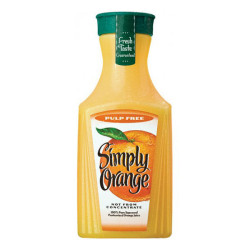
 Last week, a federal judge tossed motions for summary judgment in the consolidated class action lawsuits accusing the Coca-Cola Company of using flavorings and other chemicals in its “100% Pure Squeezed” orange juices saying that questions still remain about the classification of “orange essence oil” under federal regulations.
The orange juice class actions, consolidated into multidistrict litigation or an “MDL,” allege that Coca-Cola markets Simply Orange, Minute Maid Pure Squeezed and Premium orange juices as pure and natural, but in reality adds artificial chemically-engineered flavorings. The plaintiffs claim that this misleads consumers who pay a premium for what they think are all natural juices.
In their consolidated class action complaint, the plaintiffs alleged that “[m]ass-marketed orange juice such as Simply Orange cannot be freshly squeezed because freshly squeezed orange juice is unstable and has a short shelf-life.”
“Freshly-squeezed orange juice has a shelf life of approximately 10 days when refrigerated and between three and six months when frozen,” they claimed, arguing that the processing and storage changes the taste of the orange juice from what it should be, if it were fresh squeezed.
Although the processing procedures increase shelf life, “[f]lavorists and chemically-engineered flavorings, not the grower in the grove or the fruit itself, give Simply Orange its distinctive taste,” allege the plaintiffs. “Thus, the distinctive taste of Simply Orange is a product of science (i.e., chemically-engineered flavoring), not the fruit,” they conclude.
The Coca-Cola Company filed a motion to dismiss the consolidated class actions, as well as a motion to strike expert testimony from the record. The plaintiffs also filed a motion to strike expert testimony from Coca-Cola, as well as a motion for partial summary judgment, or for the judge to rule in their favor on a number of claims before trial.
Part of the consolidated class actions’ allegations are that orange essence oil is added to Coca-Cola orange juice products and changes the natural flavor of the juice. “[Orange] peel oil and orange essence are added to Simply Orange at levels significantly in excess of those found in raw, freshly-squeezed orange juice,” allege the plaintiffs in their filings. “Peel oil and orange essence are thus ingredients added to Simply Orange, not merely ‘incidental additives.’”
U.S. District Judge Fernando J. Gaitan Jr. tossed both Coca-Cola and the plaintiffs’ motions ruling that questions about how the federal government defines “orange essence oil” under U.S. Food and Drug Administration regulations remain.
“[T]he Court finds that questions remain as to whether orange essence oil should be considered orange oil or orange essence under the relevant FDA regulations,” ruled the judge in his order. “Additionally,” he continued. “The Court finds that questions remain as to whether the processing of the oil and/or flavor components in all defendants’ orange juice products makes those components into something other than ordinary orange oil or essence which must be disclosed on the products’ labels.”
The consumers in the multidistrict litigation are represented by Stueve Siegel Hanson LLP, Seeger Weiss LLP Carella Byrne Cecchi Olstein Brody & Agnello PC and Reese Richman LLP, among others.
The Simply Orange Mislabeling Added Flavor Class Action Lawsuit is In Re: Simply Orange Orange Juice Marketing and Sales Practices Litigation, Case No. 4:12-md-02361 in the U.S. District Court for the Western District of Missouri.
ATTORNEY ADVERTISING
Top Class Actions is a Proud Member of the American Bar Association
LEGAL INFORMATION IS NOT LEGAL ADVICE
Top Class Actions Legal Statement
©2008 – 2026 Top Class Actions® LLC
Various Trademarks held by their respective owners
This website is not intended for viewing or usage by European Union citizens.

Suing for unpaid wages in California: Recover unpaid overtime, back pay and more
April 2, 2026 | Legal News





One thought on Questions About ‘Orange Essence Oil’ Arise in Simply Orange MDL
please add me