
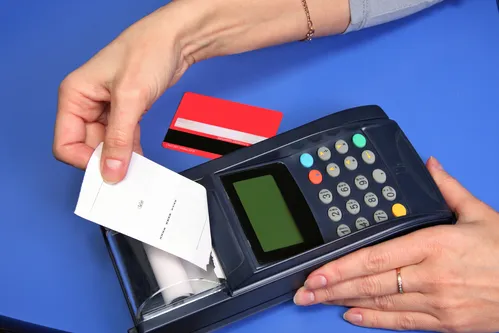
 Consumers who receive a credit or debit card receipt with too much sensitive account information printed on it may have a FACTA claim on their hands. The next thing to do would be to learn how to file a credit card receipt lawsuit.
Congress enacted FACTA, the Fair and Accurate Credit Transactions Act, in 2003 in response to growing fears about identity theft and credit fraud. FACTA is a set of amendments to the Fair Credit Reporting Act that address, among other things, how much sensitive account information can be printed on an electronically printed receipt.
These provisions are known as FACTA’s truncation requirements. They forbid any person who accepts credit or debit cards for transaction of business from printing more than the last five digits of the card number on any electronically printed receipt. Printing the card’s expiration date is also prohibited.
FACTA makes an exception for handwritten receipts and those produced by the older mechanical imprint method. Whether the requirements apply to receipts that are electronic only is still an open question; courts have not yet reached a consensus on that issue.
The statutory damage provisions of FACTA are what give it some bite. Plaintiffs can be awarded actual damages for each receipt printed that is not within FACTA compliance, plus court costs and attorneys’ fees. For each violation the plaintiff can prove were “willful,” FACTA provides for damage awards of anywhere from $100 to $1,000.
These statutory damages provisions can save a plaintiff the trouble of proving that the errant receipt resulted in credit fraud or identity theft. Just the fact that a noncompliant receipt was willfully printed can trigger a damage award.
FACTA Class Action Lawsuits
Businesses with noncompliant equipment may issue scores of FACTA-violating receipts before the problem is discovered. Cases like that can be the basis for a FACTA class action lawsuit.
The statutory damage amounts multiplied by a high number of allegedly noncompliant receipts can add up to enormous demands, giving the plaintiff class enormous leverage in negotiating a credit card lawsuit settlement.
Plaintiffs in such cases have been able to allege damage amounts in the billions. For example, a FACTA lawsuit against Costco alleged $17 billion in potential damages, and another against Cost Plus World Market alleged $3.4 billion.
In these large cases, the statutory damages provisions are so powerful that some plaintiffs have even taken to defining their alleged plaintiff class more narrowly to result in a lower alleged damage amount.
Lowering the claimed damages can prevent the defendant from arguing that the claim could result in the destruction of the business even if the actual harm to the plaintiff was only minimal.
In FACTA’s early days, some defendants argued that they simply weren’t aware of the truncation requirement. That argument has gotten weaker and weaker after more than ten years of FACTA class action litigation and the publicity generated by large damage amounts.
Knowlegeable FACTA attorneys are available to evaluate a potential FACTA claim and to explain how to file a credit card receipt lawsuit.
FACTA includes a statute of limitations that limits the time in which a FACTA lawsuit can be filed, so potential claimants wondering how to file a credit card receipt lawsuit may want to speak to an attorney sooner rather than later to prevent their claim from expiring.
Free FACTA Class Action Lawsuit Investigation
If you made one or more purchases and the retailer provided you with a receipt that contained more than the last five digits of your credit or debit card number or the expiration date, you may be eligible for a free class action lawsuit investigation and to pursue compensation for these FACTA violations.
ATTORNEY ADVERTISING
Top Class Actions is a Proud Member of the American Bar Association
LEGAL INFORMATION IS NOT LEGAL ADVICE
Top Class Actions Legal Statement
©2008 – 2026 Top Class Actions® LLC
Various Trademarks held by their respective owners
This website is not intended for viewing or usage by European Union citizens.













One thought on How to File a Credit Card Receipt Lawsuit