

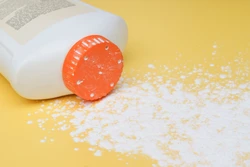
A man is suing Johnson & Johnson after his wife died of ovarian cancer following years of talcum powder exposure.
Plaintiff Kyle C. claims his deceased wife Teresa W. used Johnson’s Baby Powder for feminine hygiene purposes from 1964 until 2016. Teresa was diagnosed with ovarian cancer in May 2009. She was 45 years old at the time.
Studies Link Talcum Powder Exposure with Ovarian Cancer
Scientists believe talc particles can make their way up the genitourinary tract and into the peritoneal cavity. These talc crystals may reach the ovaries, where they can become embedded.
Over the years, a variety of studies have yielded evidence of an association between talc and ovarian cancer.
In 1971, a team of British researchers conducted the first study that suggested a link between talc products and ovarian cancer. They found talc particles embedded in tissue removed from ovarian tumors.
In 1982, an epidemiological study that showed women who used talc products on their genitals could have as much as a 92 percent increase in their risk for ovarian cancer.
Dr. Daniel Cramer, the researcher who conducted the study, approached Johnson & Johnson at the time and told them they should place a warning regarding talcum powder exposure so that women could make informed decisions before using the products. The company declined.
In 1997, a study of more than 1,000 women reported an increased risk of 42 percent for ovarian cancer in women who applied talc to their sanitary napkins.
The condom industry stopped dusting condoms with talc powder in 1996 because of the possible link between talc and cancer.
The International Association for the Research of Cancer (IARC), part of the World Health Organization, declared the perineal use of talc-based body powder is a “Group 2B” human carcinogen. The IARC found that between 16 and 52 percent of women in the world were using talc on their genitals. That practice resulted in an increase in their risk of ovarian cancer ranging from 30 to 60 percent.
In 2013, Cancer Prevention Research shared a study that showed women who experienced talcum powder exposure to their groin area had a 20 to 30 percent increased risk of ovarian cancer than women who did not use talc-based powders.
And a 2013 study concluded that compared to women who did not use talc-based powders, those who applied talcum powder to their genital area were 20 to 30 percent more likely to develop ovarian cancer.
Johnson & Johnson Accusations
Kyle’s talcum powder exposure lawsuit contends claims Johnson & Johnson “failed to disclose to the public that the product was unsafe and posed serious health hazards particularly when used in the perineal areas of women.”
The plaintiff says that when the United States National Toxicology Program deemed that talc was carcinogen, with or without the presence of asbestos fibers, Johnson & Johnson joined forces with other interested parties to defend talc.
He alleges the Cosmetic Toiletry and Fragrance Association (CTFA), now known as the PCPC, formed the Talc Interested Party Task Force (TIPTF). Johnson & Johnson and the company now known as Imerys Talc were the primary contributors and overseers of the TIPTF.
“The stated purpose of the TIPTF was to pool financial resources of these companies in an effort to collectively defend talc use at all costs and to prevent regulation of any type over the industry,” according to Kyle.
This Talcum Powder Lawsuit is Case No. 1:17-CV-308 in the U.S. District Court for the District of Columbia.
Do YOU have a legal claim? Fill out the form on this page now for a free, immediate, and confidential case evaluation. The attorneys who work with Top Class Actions will contact you if you qualify to let you know if an individual lawsuit or class action lawsuit is best for you. [In general, baby powder cancer lawsuits are filed individually by each plaintiff and are not class actions.] Hurry — statutes of limitations may apply.
ATTORNEY ADVERTISING
Top Class Actions is a Proud Member of the American Bar Association
LEGAL INFORMATION IS NOT LEGAL ADVICE
Top Class Actions Legal Statement
©2008 – 2026 Top Class Actions® LLC
Various Trademarks held by their respective owners
This website is not intended for viewing or usage by European Union citizens.
Get Help – It’s Free
Join a Free Baby Powder Cancer Class Action Lawsuit Investigation
If you used Johnson’s Baby Powder, Shower to Shower, or another talcum powder product and were diagnosed with ovarian cancer, you may have a legal claim. Family members of loved ones who died of ovarian cancer can also join. Submit your information now for a free case evaluation.
An attorney will contact you if you qualify to discuss the details of your potential case at no charge to you.
Please Note: If you want to participate in this investigation, it is imperative that you reply to the law firm if they call or email you. Failing to do so may result in you not getting signed up as a client, if you qualify, or getting you dropped as a client.











