
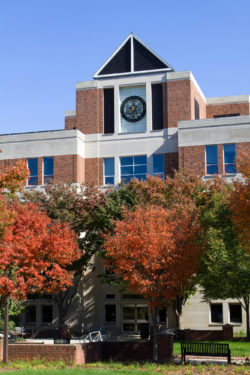
 The campus of the University of Maryland still has about 90 buildings with asbestos even decades after the onset of federal and state asbestos restrictions.
According to a recent article in the university’s student newspaper, there are still dozens of buildings on campus where asbestos can be found.
For the most part, the asbestos in those buildings doesn’t pose a risk to building occupants, according to Jack Baker, the school’s director of facilities management and maintenance.
But in areas within five university buildings, the risk of asbestos exposure is great enough to warrant closing those areas off to the public.
For decades, asbestos was used in several different construction applications because it has exceptional insulation and fire-resistance properties.
Today, buildings with asbestos do not necessarily run afoul of federal or state asbestos laws. Regulations allow asbestos to be left in place if it is unlikely to be physically disturbed.
Asbestos becomes dangerous when a physical disturbance allows asbestos fibers to become airborne. Once the fibers are in the air, nearby humans are at risk for inhaling them.
Asbestos fibers that enter the lungs can lodge in lung tissue and stay there for years, eventually triggering deadly asbestos-related respiratory diseases like asbestos lung cancer.
Most Buildings with Asbestos Don’t Pose a Risk, School Says
In more than 70 University of Maryland buildings, the remaining asbestos is considered “non-friable” – that is, it’s not likely to be physically disturbed in a way that kicks asbestos fiber into the air. Therefore those buildings are not considered to pose an asbestos exposure hazard.
But in five particular buildings – the Engineering Building, Francis Scott Key Hall, H.J. Patterson Hall, the Mitchell Building and the Reckord Armory – certain areas contain enough friable asbestos that they had to be closed off.
The university has an asbestos management plan in place that is supposed to address all the restricted areas on campus within the next year. The school estimates it can confirm only 80 percent of the actual amount of asbestos on campus because in some areas the act of taking a sample could cause asbestos to become airborne and create a risk of exposure.
Baker says that just about any building over 30 or 40 years old has asbestos in it. On the University of Maryland campus, buildings with asbestos typically have it in floor and ceiling tiles, pipe insulation, fire doors, and doors between stairwells, according to the school’s director of residential facilities Jon Dooley.
Many of the older buildings on campus have had their asbestos removed during renovations. Federal and state regulations often require developers to remove asbestos before completing any renovation on old buildings.
Dooley says most of the South Hill buildings with asbestos underwent recent renovation and are now asbestos-free. Many North Hill buildings still have not gone through asbestos abatement, he says.
The university says it has spent several million dollars on asbestos removal since 1979. Recent years have seen the removal of hundreds of cubic yards of asbestos from campus buildings every year.
Do YOU have a legal claim? Fill out the form on this page now for a free, immediate, and confidential case evaluation. The attorneys who work with Top Class Actions will contact you if you qualify to let you know if an individual asbestos lawsuit or asbestos class action lawsuit is best for you. [In general, asbestos lung cancer lawsuits are filed individually by each plaintiff and are not class actions.] Hurry — statutes of limitations may apply.
ATTORNEY ADVERTISING
Top Class Actions is a Proud Member of the American Bar Association
LEGAL INFORMATION IS NOT LEGAL ADVICE
Top Class Actions Legal Statement
©2008 – 2026 Top Class Actions® LLC
Various Trademarks held by their respective owners
This website is not intended for viewing or usage by European Union citizens.
Get Help – It’s Free
Join a Free Asbestos Lung Cancer Class Action Lawsuit Investigation
If you or a loved one were exposed to asbestos and developed mesothelioma, lung cancer, or cancer in the lining of the lungs, abdomen or chest cavity, you may be able to take legal action against the companies responsible. Don’t delay – in most states the statute of limitations is two years to file an asbestos lawsuit after you’re diagnosed. Obtain a free and confidential case evaluation be filling out the form below.
An attorney will contact you if you qualify to discuss the details of your potential case at no charge to you.
Please Note: If you want to participate in this investigation, it is imperative that you reply to the law firm if they call or email you. Failing to do so may result in you not getting signed up as a client, if you qualify, or getting you dropped as a client.
Oops! We could not locate your form.







2 thoughts onUniversity of Maryland Restricts Areas in Five Buildings with Asbestos