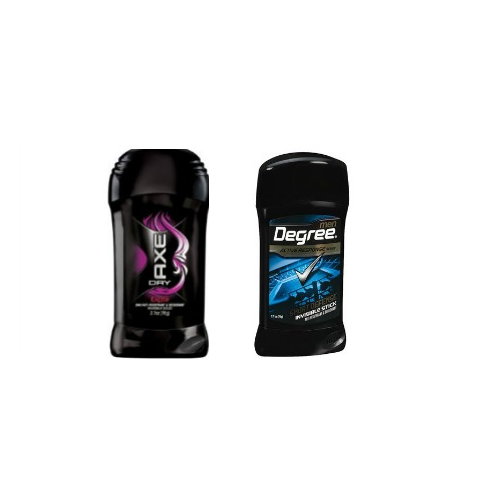
 Last week, the class action lawsuit accusing Unilever United States Inc. of deceptively marketing Axe and Degree brand products by using large packaging to disguise how much product consumers receive was dismissed with prejudice.
In September of last year, lead plaintiffs in two class action lawsuits alleged that Unilever and Proctor & Gamble sold their brand-name deodorants in oversized packaging to purposefully mislead consumers into believing they’re getting a fair deal. The plaintiffs allege that Degree and Axe deodorants are sold in containers that are about 5.75 inches high and 2.75 inches wide, but the product inside is 3 inches long and 2.5 inches wide.
“The size of the container has nearly 3 inches of slack-fill in height and is designed to give the false impression that there is more product than actually packaged,” the plaintiffs argue in their Unilever deodorant lawsuit.
Unilever filed a motion to dismiss the class action lawsuit arguing the claims are preempted under the Federal Food, Drug, and Cosmetic Act. U.S. District Judge J. Paul Oetken agreed, finding that the U.S. Food and Drug Administration has the authority to regulate alleged “slack-fill” — extraneous packaging used to make the product portion appear more generous — in foods, drugs, and cosmetics. However, the FDA has chosen only to do so with foods, despite invitations to regulate it in other products, making it tantamount to a conscious decision to permit slack-fill in non-food products.
“The FDA’s failure to regulate in this area constitutes strong evidence that the FDA considered the issue of slack-fill in drugs and cosmetics and decided that slack-fill in those products is insufficiently misleading to warrant regulation,” the judge wrote in his order dismissing the Unilever deodorant lawsuit.
The judge dismissed the claims with prejudice, not allowing the plaintiffs to amend the class action because, according to the judge’s order, it would be futile to try.
In March, Unilever filed a motion to dismiss the deodorant sizing class action lawsuit, arguing that “[p]laintiffs’ slack-fill claims are preempted because the FDA has chosen not to enact regulations for cosmetics and [over-the-counter] drugs prohibiting nonfunctional slack-fill, as it did with respect to food products.”
“Applying FDA food regulations to cosmetics and [over-the-counter] drugs, as plaintiffs here seek to do, would impose preempted state law requirements on Unilever,” Unilever continued.
Judge Oetken also dismissed the plaintiffs’ false advertising claims in his order. The judge said that the plaintiffs’ false advertising claims failed because they were based on product packaging and labeling regulated under the FDCA. Judge Oetken noted that the FDCA does not cover nonlabel advertising.
“But plaintiffs have not pleaded facts sufficient to give rise to the inference that any of Unilever’s nonlabeling advertisements are false,” the judge noted in his order. “Indeed, plaintiffs have not pleaded the content of any of Unilever’s nonlabeling advertisements, let alone facts demonstrating the falsity of those advertisements or reliance on them.”
The class action brought in the Southern District of New York against Procter & Gamble alleging similar claims is still pending.
The plaintiffs in both class action lawsuits are represented by C.K. Lee of Lee Litigation Group PLLC.
The Unilever Deodorant Packaging Size Class Action Lawsuit is Bimont, et al. v. Unilever United States Inc., Case No. 1:14-cv-07749, in the U.S. District Court for the Southern District of New York.
The Procter & Gamble Deodorant Packaging Size Class Action Lawsuit is Tjokronolo, et al. v. The Procter & Gamble Co., et al., Case No. 1:14-cv-05577, in the U.S. District Court for the Eastern District of New York.

Legal help for mental harm caused by social media addiction in young users
May 6, 2026 | social media