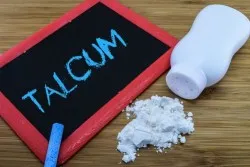
 Talcum powder has been promoted for decades by companies claiming that it helps eliminate friction, is gentle on the skin and provides a clean, pleasant scent.
Talcum powder is commonly used by mothers to reduce babies’ diaper rashes and by women in general as a personal hygiene product.
Women using the product for personal hygiene purposes may want to rethink their use, however, as a growing number of studies have found that the use of talcum powder in the genital area may increase a woman’s risk of developing ovarian cancer.
Talcum Powder Risk
Talcum powder is typically marketed as “talc powder,” “baby powder” or “body powder” and contains the mineral talc. Although it is often used by women as part of their daily hygiene regimen, the use of talcum powder on the genitals and perineal area, either through direct application or by applying it to sanitary napkins, has been associated with an increased risk of ovarian cancer.
Studies have found that the talcum powder may travel into the genital tract, causing inflammation. Frequent, long-term use of talc powder in these areas doubled or tripled the risk of developing ovarian cancer.
Ovarian Cancer
Ovarian cancer is a relatively rare yet deadly form of cancer. Unlike some other types of cancer, ovarian cancer may be unaccompanied by symptoms.
Many diagnoses of ovarian cancer are made only after the disease has spread to other parts of the body, such as throughout the pelvic region or into the abdomen. Once this has occurred, ovarian cancer is much more difficult to treat.
The American Cancer Society estimates that in 2015, ovarian cancer will be detected in 21,290 women, and 14,180 will die during the year of the disease.
One expert on the subject of baby powder ovarian cancer, Harvard epidemiologist Daniel Cramer, says that dusting talcum powder in the perineal area leads to approximately 10,000 cases of ovarian cancer each year, or 45 percent of the total new annual cases.
Talcum Powder and Ovarian Cancer Links
In 2013, Cancer Prevention Research published “Genital powder use and risk of ovarian cancer: a pooled analysis of 8,525 cases and 9,859 controls,” which found that “genital powder use was associated with a modest increased risk of epithelial ovarian cancer relative to women who never used powder.”
A 2010 study conducted by Harvard epidemiologist Dr. Margaret Gates and others found a positive association among postmenopausal women, with women who had ever used talcum powder linked to a 21 percent increase in risk of endometrial cancer, while regular use was associated with a 24 percent increase in risk.
In 2003, an analysis of 16 observational studies on the association between perineal talcum powder use and ovarian cancer found a statistically significant result that suggested a 33 percent increased risk of ovarian cancer among women who used talc in the perineal area.
The American Cancer Society reports that the risk of ovarian cancer may be increased with perineal talcum powder use and that research continues to determine the magnitude of the increased risk.
Additionally, the International Agency for Research on Cancer (IARC), part of the World Health Organization, classifies the perineal use of talc-based body powder as “possibly carcinogenic to humans.”
Talcum Powder Lawsuits
The debate over talcum powder ovarian cancer is also being weighed in U.S. court system.
In one talcum powder lawsuit against Johnson & Johnson that reached a jury verdict in 2013, a woman in her 50s named Deane B. claimed that her 2006 ovarian cancer diagnosis was directly caused by years of using talc powder for feminine hygiene, and that the manufacturer knew of the potential link.
She reported more than 30 years of talcum powder use, including the Johnson & Johnson product Shower to Shower body powder, as part of her personal hygiene routine.
The South Dakota jury found that Johnson & Johnson failed to warn consumers of the link between the use of their talc powders for feminine hygiene and an increased risk of ovarian cancer.
More recently in 2016, Johnson & Johnson was ordered to pay $72 million in damages to the family of 62-year-old Jackie F., who died from ovarian cancer after using talcum powder products for feminine hygiene.
Johnson & Johnson still faces more than 1,000 talcum powder lawsuits in state courts.
If you or your mother, sister, daughter, or other loved one developed ovarian cancer after using talcum powder, an experienced product liability attorney wants to help. You may be entitled to compensation for your pain and suffering, medical bills, and lost wages.
Do YOU have a legal claim? Fill out the form on this page now for a free, immediate, and confidential case evaluation. The attorneys who work with Top Class Actions will contact you if you qualify to let you know if an individual lawsuit or class action lawsuit is best for you. [In general, baby powder cancer lawsuits are filed individually by each plaintiff and are not class actions.] Hurry — statutes of limitations may apply.
ATTORNEY ADVERTISING
Top Class Actions is a Proud Member of the American Bar Association
LEGAL INFORMATION IS NOT LEGAL ADVICE
Top Class Actions Legal Statement
©2008 – 2026 Top Class Actions® LLC
Various Trademarks held by their respective owners
This website is not intended for viewing or usage by European Union citizens.
Get Help – It’s Free
Join a Free Baby Powder Cancer Class Action Lawsuit Investigation
If you used Johnson’s Baby Powder, Shower to Shower, or another talcum powder product and were diagnosed with ovarian cancer, you may have a legal claim. Family members of loved ones who died of ovarian cancer can also join. Submit your information now for a free case evaluation.
An attorney will contact you if you qualify to discuss the details of your potential case at no charge to you.
Please Note: If you want to participate in this investigation, it is imperative that you reply to the law firm if they call or email you. Failing to do so may result in you not getting signed up as a client, if you qualify, or getting you dropped as a client.