
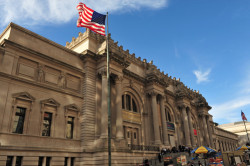
 The Metropolitan Museum of Art in N.Y. agreed to reword its signs and website to settle a class action lawsuit that accuses the museum of trying to mislead visitors into paying an entrance fee when none is required.
The Met Museum draws more than 6 million visitors annually and recommends an admission fee of $25 for adults, $17 for seniors and $12 for students. The Met has agreed to replace its admissions verbiage from “recommended admission” to “suggested admission.”
In 2013, a pair of visitors from the Czech Republic and two New York residents sued the Met Museum, claiming that the admission fee violated the terms of the museum’s lease. The Met Museum class action lawsuit argued that visitors thought they had to pay $25, when in fact they could pay whatever they wanted. Although parts of the lawsuit were thrown out, the Met Museum agreed to settle.
However, unsatisfied with negotiations, New York residents Theodore Grunewald and Patricia Nicholson, who initially filed a class action lawsuit against the Met Museum four months prior to the settled suit, split from the Class in July.
The pair then filed a separate similar Met Museum class action lawsuit, seeking an injunction against the museum’s allegedly deceptive admissions policy. The Met Museum is seeking to dismiss that case.
Under the settlement announced on Feb. 26, the Met Museum, the largest in the United States and considered one of the world’s most prestigious art institutions, will now say the admission fee is “suggested” rather than “recommended.” A lawyer for the plaintiffs, Andrew Celli Jr., says the new signs ensure that the Met Museum is open to people of all economic levels.
The Met Museum Admissions Policy settlement agreement, which needs to be approved in court, brings to an end to this three-year lawsuit that first disputed the museum’s right to charge visitors and then criticized its semantics.
All three Metropolitan Museum of Art sites will adhere to the same “pay what you wish” policy.
Celli Jr. said the settlement affects the font size and placement of the words rather than just replacing “recommended” with “suggested.”
“‘Suggested’ is now the same size as the word ‘admission’,” he said. “I think it really brings the museum back to where it should have been, and where it was historically.”
The Met Museum CEO, Thomas P. Campbell, issued a statement that the upcoming opening of The Met Breuer “presented an ideal time to put this case behind” it and clear any confusion regarding the museum’s admissions policy.
“All of our recent branding and marketing work has been aimed at simplifying our message of welcome to the public and emphasizing that we are accessible to the widest possible audience — now at three locations,” Campbell conveyed. “The new admission signs will represent another step in this effort.”
Celli Jr. said they were satisfied with the settlement outcome.
“This settlement reflects that the museum is truly a public institution that welcomes visitors of all economic levels,” Celli Jr. stated. “We are gratified that our lawsuit helped persuade the museum’s trustees to do the right thing, play it straight with the public, and let people know that they have the right to ‘pay what they wish’ to see the museum’s first-class collection.”
The putative class is represented by Andrew G. Celli Jr. of Emery Celli Brinckerhoff & Abady LLP.
The Met Museum Class Action Lawsuits are Filip Saska, et al. v. The Metropolitan Museum of Art, Case No. 650775/2013, and Theodore Grunewald, et al. v. The Metropolitan Museum of Art, Case No. 158002/2012, both in the New York Supreme Court, County of New York.
ATTORNEY ADVERTISING
Top Class Actions is a Proud Member of the American Bar Association
LEGAL INFORMATION IS NOT LEGAL ADVICE
Top Class Actions Legal Statement
©2008 – 2026 Top Class Actions® LLC
Various Trademarks held by their respective owners
This website is not intended for viewing or usage by European Union citizens.

Suing for unpaid wages in California: Recover unpaid overtime, back pay and more
April 2, 2026 | Legal News












One thought on Met Museum Settles Class Action Over ‘Recommended’ Admissions Fee