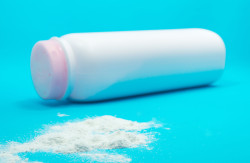
 A widower is suing Johnson & Johnson over his wife’s alleged talc powder cancer death.
Kenneth B.’s wife was born in 1963, and began applying talcum powder-based products to her perineal area as a teenager in the 1970s.
This was a habit she kept throughout her life; one that was encouraged by marketing of Johnson & Johnson at the time.
In the 1960s and 1970s, Johnson & Johnson baby powder was advertised to absorb “excess wetness” to keep skin dry and comfortable. In marketing directed at women, the bottle stated, “For you, use every day to help feel soft, fresh, and comfortable.”
During the same period of time, the defendants introduced Shower to Shower, another talc-based powder marketed to women.
A sing-songy slogan of “A sprinkle a day helps keep odor away” played on radio and TV through the 1980s. Shower to Shower was promoted for use all over the body.
Mrs. B. was diagnosed with ovarian cancer in 2011. She had a total hysterectomy and underwent subsequent treatment. She died of ovarian cancer at age 52 years on Aug. 6, 2015.
Studies Show Talc Powder Cancer Death Link
Dr. W.J. Henderson led a team that conducted the first study that suggested a link between talc products and ovarian cancer back in 1971.
Also in 1971, researchers in Wales found talc particles embedded in ovarian and cervical tumors. It is believed that talc crystals creep up the genitourinary tract and into the peritoneal cavity. The ovaries are open-ended in the peritoneal cavity, and the talc crystals settle in there and cause irritation.
In 1982, Dr. Daniel Cramer published a study that showed women who used talc products on their genitals showed a 92 percent increase in ovarian cancer.
Dr. Cramer was so convinced of the talc powder cancer death link that he approached Johnson & Johnson at the time and told them they should place a warning on talcum powders so that women could make informed decisions on the risks before purchasing the products.
Over the years, more than a dozen studies have backed up the talc powder cancer death claim.
In 1997, a study of more than 1,000 women declared an increased risk of 42 percent for ovarian cancer in women who applied talc to their sanitary napkins.
A case-control study of 1,400 women in central California found a 37 percent increased risk of epithelial ovarian cancer and a 77 percent increased risk of serous invasive ovarian cancer in those who used talc on the genital area in 2004.
The former begins on the outer layer that covers the ovary; the latter starts in cells at the far end of the fallopian tube.
The California study also looked at women who used cornstarch-based powders as an alternative, and none of them saw an increased risk of ovarian cancer.
Over the years, scientists have shown a tendency toward talc powder cancer deaths in women who use talcum powder on their genitals.
FDA Refuses to Back Warnings
The FDA faced a petition from the Cancer Prevention Coalition in 1994 and in 2008 when the nonprofit agency was trying to convince the FDA to add talc warning labels.
In refusing these demands, the FDA says there is “no conclusive evidence” that talc causes ovarian cancer.
Still, the FDA did concede that talc “may elicit a foreign-body-type reaction and inflammatory response that, in some exposed women, may progress to epithelial cancers.”
The FDA statements fall short of warning women to refrain from using talc-based products on their private areas.
The Talc Powder Cancer Death Lawsuit is Case No. 6:16-cv-01120 in the U.S. District Court for the Western District of Louisiana, Lafayette Division.
Do YOU have a legal claim? Fill out the form on this page now for a free, immediate, and confidential case evaluation. The attorneys who work with Top Class Actions will contact you if you qualify to let you know if an individual lawsuit or class action lawsuit is best for you. [In general, baby powder cancer lawsuits are filed individually by each plaintiff and are not class actions.] Hurry — statutes of limitations may apply.
ATTORNEY ADVERTISING
Top Class Actions is a Proud Member of the American Bar Association
LEGAL INFORMATION IS NOT LEGAL ADVICE
Top Class Actions Legal Statement
©2008 – 2026 Top Class Actions® LLC
Various Trademarks held by their respective owners
This website is not intended for viewing or usage by European Union citizens.
Get Help – It’s Free
Join a Free Baby Powder Cancer Class Action Lawsuit Investigation
If you used Johnson’s Baby Powder, Shower to Shower, or another talcum powder product and were diagnosed with ovarian cancer, you may have a legal claim. Family members of loved ones who died of ovarian cancer can also join. Submit your information now for a free case evaluation.
An attorney will contact you if you qualify to discuss the details of your potential case at no charge to you.
Please Note: If you want to participate in this investigation, it is imperative that you reply to the law firm if they call or email you. Failing to do so may result in you not getting signed up as a client, if you qualify, or getting you dropped as a client.