 The widower of a woman who died in 2014 after undergoing hysterectomy with a power morcellator has filed a wrongful death lawsuit against Ethicon and Johnson & Johnson.
Plaintiff Larry P. alleges that the power morcellator device manufactured by Johnson & Johnson’s Ethicon subsidiary caused his wife’s cancer to be disseminated during a robotic hysterectomy.
The morcellation lawsuit claims that Kimberly P. underwent a total laparoscopic robotic power morcellation hysterectomy and cystoscopy in June 2011.
During the surgical procedure, a power morcellator made and sold by J&J’s Ethicon division was used to cut, shred, and remove uterine fibroid specimens and to morcellate her uterus. Prior to her surgery, there was no evidence that she suffered from any form of leiomyosarcoma cancer.
However, the morcellation device allegedly caused Kimberly’s undiagnosed leiomyosarcoma cancer to spread throughout her omentum cavity, increasing the cancer from its earliest (and most treatable) stage to its most deadly form. She underwent several additional procedures related to the disseminated cancer and it further spread.
Plaintiff Larry alleges Ethicon and Johnson & Johnson knew that power morcellators could spread undetected cancer but failed to inform the public and medical community about this risk. Kimberly died of leiomyosarcoma cancer in March 2014, about 3 years after undergoing the initial surgery.
What is a Power Morcellator?
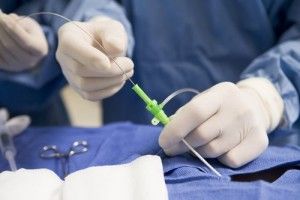
Power morcellators are medical devices used during minimally invasive laparoscopic hysterectomy and fibroid removal procedures. The device grinds up the uterus and uterine fibroids, allowing the easy removal of the tissues through a small incision in the abdomen.
Morcellator use has decreased over the past year because of the risk that the devices may cause the spread of aggressive uterine cancers that were undiagnosed in the uterus.
Uterine Sarcoma (Leiomyosarcoma)
Leiomyosarcoma is a rare but highly aggressive form of cancer that occurs in smooth muscle cells of the uterus or gastrointestinal tract. Uterine leiomyosarcoma develops in the muscular part of the uterus, and typically occurs in women between the ages of 40 and 60.
Uterine tumors are highly metastatic, with nearly 70 percent of patients who have had their tumors removed seeing a recurrence within 8 to 16 months.
In nearly 80 percent of patients who have a recurrence, the disease has spread to other parts of the body such as the ovaries, lungs or liver. When this occurs, it is referred to as metastatic leiomyosarcoma and classified as either stage III or IV.
Patients with non-metastatic leiomyosarcoma have a 5-year survival rate of approximately 50 percent. While the 5-year survival rate for patients with metastatic leiomyosarcoma is between 4 and 16 percent.
FDA Warns Power Morcellators May Spread Cancer
The National Institutes of Health (NIH) has estimated that fibroid removal surgery is a $2.1 billion annual industry and that most women will be diagnosed with uterine fibroids at some time in their life.
By promoting the use of laparoscopic power morcellators without adequately researching the risks or warning the public, it appears that manufacturers placed their desire for profits ahead of safety.
In April 2014, the U.S. Food & Drug Administration (FDA) issued a warning which stated that doctors should not use power morcellators during hysterectomy or myomectomy surgery because the devices may spread cancerous uterine tissue to other areas in the body.
Based on current information, FDA has determined that approximately 1 in 350 women who have a hysterectomy or myomectomy surgery for uterine fibroids have an undiagnosed type of cancer known as uterine sarcoma.
If morcellation is used on these women, there is an increased risk that the morcellator will spread malignant tissue to the abdomen or pelvis.
Morcellator Cancer Lawsuits
As of Oct. 20, The U.S. Judicial Panel on Multidistrict Litigation (JPML) has consolidated at least 28 federally-filed morcellator injury and death lawsuits before Judge Kathryn H. Vratil in the District of Kansas. The litigation is In Re: Ethicon, Inc., Power Morcellator Products Liability Litigation, MDL No. 2652.
The Morcellator Cancer Lawsuit is Case No. 6:15-cv-06100-SOH in the U.S. District Court for the Western District of Arkansas, Hot Springs Division.
Do YOU have a legal claim? Fill out the form on this page now for a free, immediate, and confidential case evaluation. The morcellation cancer attorneys who work with Top Class Actions will contact you if you qualify to let you know if an individual lawsuit or class action lawsuit is best for you. [In general, morcellator cancer lawsuits are filed individually by each plaintiff and are not class actions.] Hurry — statutes of limitations may apply.
ATTORNEY ADVERTISING
Top Class Actions is a Proud Member of the American Bar Association
LEGAL INFORMATION IS NOT LEGAL ADVICE
Top Class Actions Legal Statement
©2008 – 2026 Top Class Actions® LLC
Various Trademarks held by their respective owners
This website is not intended for viewing or usage by European Union citizens.
Get Help – It’s Free
Join a Free Morcellation Cancer Class Action Lawsuit Investigation
If you or a loved one were diagnosed with cancer in the uterus, pelvis or abdomen within two years of undergoing surgery for a myomectomy (removal of fibroids), hysterectomy (removal of the uterus), oophorectomy (removal of the ovaries), or salpingectomy (removal of fallopian tubes), you may have a legal claim. See if you qualify by filling out the short form below.
An attorney will contact you if you qualify to discuss the details of your potential case at no charge to you.
Oops! We could not locate your form.