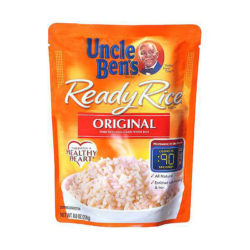
 A California woman can continue to bring her Uncle Ben’s Ready Rice class action lawsuit after a federal judge denied the defendant’s motion to dismiss.
U.S. District Judge Vince Chhabria denied a motion for dismissal by defendant Mars Inc., finding that the plaintiff’s allegations were sufficient to state a claim under state laws that prohibit misleading labeling.
Judge Chabria noted that the allegations brought by plaintiff Melissa Vigil, if they are true, would show that the defendant’s labeling for Uncle Ben’s Ready Rice “could cause a reasonable consumer to be misled into thinking that the package contains a greater volume of rice than it actually does.”
Vigil’s success against Mars’s motion for dismissal comes after her original Ready Rice class action lawsuit was dismissed in October 2016 for failure to state a claim.
Judge Chhabria issued that dismissal with leave to amend, allowing Vigil to correct the defects in her complaint and reassert her allegations.
In her most recent amended complaint, Vigil says the volume of a serving of Ready Rice, once cooked, falls well short of the serving size indicated on the product’s packaging.
According to her Ready Rice class action lawsuit, the label for Ready Rice says each package contains “About 2” servings of rice, at one cup per serving. So a consumer could reasonably expect to get two cups of cooked rice from each package, Vigil claims.
But the actual yield is much lower, the lawsuit states.
“[T]he true yield of the prepared Ready Rice product is never two cups, but rather consistently yields only 66 to 75 percent of the amount represented on the label,” Vigil claims. “Accordingly, consumers purchasing Defendants’ Ready Rice products are materially short changed by at least 25-33 percent.”
Vigil says she purchased various varieties of Uncle Ben’s Ready Rice on at least three different occasions, most recently in December 2015. She alleges each package yielded only about 1 1/3 and 1 1/2 cups of prepared rice.
Her Ready Rice class action lawsuit goes into extensive detail about the FDA’s minute regulations that govern how serving size and servings per package must be represented on a food product’s nutrition label.
Federal regulations govern precisely how to measure the Reference Amount Customarily Consumed Per Eating Occasion, or RACCC, for each product. The RACC, measured in metric units, must then be converted to a serving size expressed in fractions of a cup.
By failing to conform to these regulations, Vigil alleges, Mars has produced label information that could reasonably be expected to deceive consumers.
Vigil proposes to represent a plaintiff Class that would include all persons who purchased Uncle Ben’s Ready Rice in California within the four years before the filing of this Ready Rice class action lawsuit.
She seeks a court order barring defendant Mars from continuing the allegedly unlawful acts complained of here. She also seeks damages, restitution, disgorgement of profits, and reimbursement of attorneys’ fees and costs of litigation.
Vigil is represented by attorneys Jeffrey Krinsk, Trenton Kashima, and William Restis of Finkelstein & Krinsk LLP.
The Uncle Ben’s Ready Rice Class Action Lawsuit is Melissa L. Vigil v. Mars Inc., Case No. 3:16-cv-03818, in the U.S. District Court for the Northern District of California.
UPDATE: On July 27, 2017, Mars Inc. says a class action lawsuit alleging the company misleads consumers about how much rice is in its packets of Uncle Ben’s Ready Rice should be dismissed because the plaintiff is unclear about the serving sizes.
ATTORNEY ADVERTISING
Top Class Actions is a Proud Member of the American Bar Association
LEGAL INFORMATION IS NOT LEGAL ADVICE
Top Class Actions Legal Statement
©2008 – 2026 Top Class Actions® LLC
Various Trademarks held by their respective owners
This website is not intended for viewing or usage by European Union citizens.

Suing for unpaid wages in California: Recover unpaid overtime, back pay and more
April 2, 2026 | Legal News