

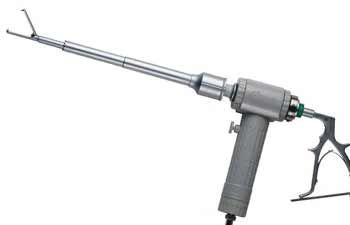
 The husband of a South Carolina woman has filed a wrongful death lawsuit, just one of a growing number uterine cancer lawsuits involving power morcellators.
Plaintiff John O. alleges that a device manufactured by Johnson & Johnson’s Ethicon subsidiary caused his wife’s cancer to be disseminated during a robotic partial hysterectomy. The complaint was filed on Feb. 3, following the death of Mrs. Cynthia O. due to the spread of a rare, malignant cancer called leiomyosarcoma.
Cynthia underwent a total laparoscopic robotic power morcellation hysterectomy and cystoscopy in October 2012. During this surgical procedure, a power morcellator made and sold by J&J’s Ethicon division was used to cut, shred, and remove three large uterine fibroid specimens and to partially morcellate her uterus. Prior to her surgery, there was no evidence that she suffered from any form of leiomyosarcoma cancer.
However, the morcellation device allegedly caused Cynthia’s undiagnosed leiomyosarcoma cancer to spread throughout her abdomen, increasing the cancer from its earliest (and most treatable) stage to its most deadly form. She subsequently died of leiomyosarcoma cancer in September 2014.
FDA Warning Against Power Morcellators
Laparoscopic surgery offer benefits for many patients being treated for benign uterine fibroid tumors (leiomyomas), such as allowing for shorter postoperative recovery time, reduced risk of infection, and less pain compared with more invasive abdominal hysterectomy and myomectomy. When laparoscopic hysterectomy and myomectomy procedures are performed with the assistance of a power morcellator, the morcellator cuts the tissue into small fragments that may then be extracted via a small incision.
The U.S. Food and Drug Administration (FDA) issued an updated safety communication warning against the use of laparoscopic power morcellators during hysterectomy and myomectomy procedures in most women. The warning, released on Nov. 24, 2014, cites concerns that power morcellators “may contribute to the spread of occult gynecologic cancer cells” in female patients.
The FDA estimates that 1 out of 350 women who undergo hysterectomy or myomectomy for presumed uterine fibroids actually have unsuspected leiomyosarcoma, a malignant, cancerous tumor. When power morcellation is used during surgery, these women are at increased risk for development of dispersed cancer growth within the abdomen and pelvis, reducing the likelihood of long-term survival.
Power Morcellation Lawsuits
The power morcellation lawsuit accuses Ethicon of negligence, breach of implied warranties, loss of consortium and is seeking both compensatory and punitive damages. A jury trial has been demanded. John’s wrongful death lawsuit joins a growing number of similar power morcellation lawsuits that are now being pursued on behalf of individuals nationwide diagnosed with disseminated uterine cancer or leiomyosarcoma following a minimally invasive, laparoscopic surgery.
The Power Morcellation Lawsuit is Case No: 6:15-cv-00516-MGL, in the U.S. District Court for the District of South Carolina, Greenville Division.
Do YOU have a legal claim? Fill out the form on this page now for a free, immediate, and confidential case evaluation. The morcellation cancer attorneys who work with Top Class Actions will contact you if you qualify to let you know if an individual lawsuit or class action lawsuit is best for you. [In general, morcellator cancer lawsuits are filed individually by each plaintiff and are not class actions.] Hurry — statutes of limitations may apply.
ATTORNEY ADVERTISING
Top Class Actions is a Proud Member of the American Bar Association
LEGAL INFORMATION IS NOT LEGAL ADVICE
Top Class Actions Legal Statement
©2008 – 2026 Top Class Actions® LLC
Various Trademarks held by their respective owners
This website is not intended for viewing or usage by European Union citizens.
Get Help – It’s Free
Join a Free Morcellation Cancer Class Action Lawsuit Investigation
If you or a loved one were diagnosed with cancer in the uterus, pelvis or abdomen within two years of undergoing surgery for a myomectomy (removal of fibroids), hysterectomy (removal of the uterus), oophorectomy (removal of the ovaries), or salpingectomy (removal of fallopian tubes), you may have a legal claim. See if you qualify by filling out the short form below.
An attorney will contact you if you qualify to discuss the details of your potential case at no charge to you.
Oops! We could not locate your form.











