
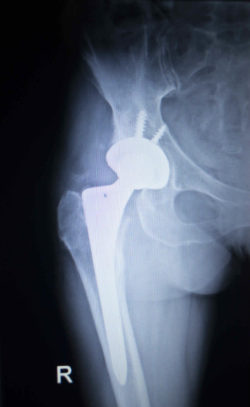
 A consumer recently filed a lawsuit alleging that DePuy hip replacement complications caused him serious damage including bone and tissue loss.
Plaintiff Patrick G. recently filed a lawsuit against DePuy Orthopaedics Inc., Johnson & Johnson Inc. and several other companies, alleging that DePuy hip replacement complications led to health problems and revision surgery.
Patrick says he was implanted with two Pinnacle hip replacements, one in each hip, in 2005. After surgery, Patrick claims that he suffered from DePuy hip replacement complications including severe inflammation, severe pain, tissue and bone loss and other related diseases.
He had his left hip implant explanted in May 2016 and plans to have his right hip implant explanted in the near future.
Patrick argues that he experienced economic and non-economic damages as a result of DePuy hip replacement complications including medical expenses, loss of earnings, disfigurement, pain and suffering, mental anguish and emotional distress.
The Pinnacle hip replacement was launched in 2001 as a metal-on-metal hip replacement system for joints damaged due to fracture, osteoarthritis, rheumatoid arthritis and avascular necrosis. The device was allegedly designed to provide pain relief and smooth range of motion.
DePuy reportedly advertised the Pinnacle replacement as using “TrueGlide” technology, which allows the body to create a thin film of lubrication between the implant’s surfaces, enabling “a more fluid range of motion”.
However, the DePuy Pinnacle lawsuit claims that the implant is not as effective as it was marketed to be, with over 1,300 adverse reports submitted to the U.S. Food and Drug Administration (FDA).
Patrick claims that wear of the implant components may generate metal debris which can be released into the surrounding tissue and bloodstream. This can allegedly result in DePuy hip replacement complications including metallosis, tissue death, bone erosion and development of tumors. The condition can be detected by high cobalt-chromium ions in the bloodstream.
The DePuy hip lawsuit argues that, because the Pinnacle device was approved through the FDA’s 510(k) process, it was not sufficiently tested for safety and effectiveness. The 510(k) process allows devices to be quickly approved by proving they are similar enough to an approved device already on the market.
“As such, under the 510(k) process, Defendants were able to market the Pinnacle Device with virtually no clinical or non-clinical trials or FDA review of the implant for safety and effectiveness,” the lawsuit states.
The Pinnacle device is reportedly not the first product to experience DePuy hip replacement complications. In 2010, DePuy recalled a similar hip replacement system, the ASR hip replacement, due to reports of early failure, metallosis, and other serious health problems.
Patrick claims that DePuy hip replacement complications will soon lead the company to recall the Pinnacle device as it did the ASR.
Patrick accuses the defendants of negligence, strict products liability – manufacturing defect, strict product liability – design defect, strict products liability – inadequate warning, breach of warranties, negligent misrepresentation, and fraud. His DePuy hip lawsuit seeks compensatory damages, punitive damages, court costs and attorneys’ fees.
The DePuy Hip Lawsuit is Case No. 3:18-cv-01308-K in the United States District Court for the Northern District of Texas.
Do YOU have a legal claim? Fill out the form on this page now for a free, immediate, and confidential case evaluation. The hip implant attorneys who work with Top Class Actions will contact you if you qualify to let you know if an individual lawsuit or class action lawsuit is best for you. [In general, metal hip implant lawsuits are filed individually by each plaintiff and are not class actions.] Hurry — statutes of limitations may apply.
ATTORNEY ADVERTISING
Top Class Actions is a Proud Member of the American Bar Association
LEGAL INFORMATION IS NOT LEGAL ADVICE
Top Class Actions Legal Statement
©2008 – 2026 Top Class Actions® LLC
Various Trademarks held by their respective owners
This website is not intended for viewing or usage by European Union citizens.
Get Help – It’s Free
Join a Free DePuy, Zimmer Hip Replacement Lawsuit Investigation
An attorney will contact you if you qualify to discuss the details of your potential case at no charge to you.
PLEASE NOTE: If you want to participate in this investigation, it is imperative that you reply to the law firm if they call or email you. Failing to do so may result in you not getting signed up as a client or getting you dropped as a client.
E-mail any problems with this form to:
[email protected].
Oops! We could not locate your form.
In general, metal hip implant lawsuits are filed individually by each plaintiff and are not class actions. After you fill out the form, the attorneys who work with Top Class Actions will contact you if you qualify to let you know if an individual lawsuit or class action lawsuit is best for you.
ATTORNEY ADVERTISING
The choice of a lawyer is an important decision and should not be based solely on advertisements.
Counsel responsible for this advertisement includes Anthony Johnson at:
Johnson Firm
PAID ATTORNEY ADVERTISEMENT: THIS WEB PAGE IS AN ADVERTISEMENT AND THE PARTICIPATING ATTORNEY(S) ARE INCLUDED BECAUSE THEY PAY AN ADVERTISING FEE. It is not a lawyer referral service or prepaid legal services plan. Top Class Actions is not a law firm. Top Class Actions does not endorse or recommend any lawyer or law firm who participates in the network, nor does it analyze a person’s legal situation when determining which participating lawyers receive a person’s inquiry. It does not make any representation and has not made any judgment as to the qualifications, expertise or credentials of any participating lawyer. No representation is made that the quality of the legal services to be performed is greater than the quality of legal services performed by other lawyers. The information contained herein is not legal advice. Any information you submit to Top Class Actions does not create an attorney-client relationship and may not be protected by attorney-client privilege. Do not use the form to submit confidential, time-sensitive, or privileged information. All photos are of models and do not depict clients. All case evaluations are performed by participating attorneys.












One thought on DePuy Hip Replacement Complications Prompt Consumer Lawsuit