 A dozen members of congress are calling for an investigation into why the FDA took so long to warn about the risk of cancer associated with the use of power morcellators.
The request comes from a bipartisan group of 12 representatives led by Rep. Mike Fitzpatrick of Pennsylvania. They are asking the Government Accountability Office to investigate why the FDA allowed marketing of power morcellators without a warning for over 20 years. They note that hundreds and possibly thousands of women have died from morcellator cancer.
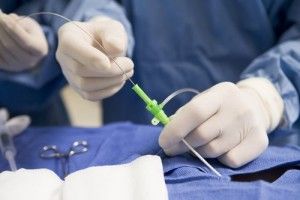
A power morcellator is a device used in laparoscopic surgery to shred and remove tissue. It can be used in hysterectomy or uterine fibroid surgery to remove tissue through the smaller incisions used in laparoscopic surgery. These devices have been on the market since they were first approved by the FDA in 1991.
By shredding tissue inside the abdomen, a power morcellator can cut up previously undetected, or “occult,” cancerous tissue and distribute it elsewhere in the body, potentially causing the cancer to spread and advance rapidly.
The FDA issued a warning in April 2014 recommending that surgeons stop using power morcellators in certain patients. The FDA has since added a warning to the products’ labeling. The agency cited studies estimating that as many as one in 350 of women undergoing these procedures has an undetected cancer putting them at risk for morcellator cancer.
The congressional request asks the GAO to determine whether manufacturers followed the FDA’s adverse event reporting requirements, what training manufacturers provided to physicians, and what action the FDA is taking to determine whether to take power morcellators off the market.
A spokesperson from the GAO said the agency will evaluate the request and determine whether to conduct an investigation.
The effort to get congressional action on morcellator cancer has been driven in large part by Dr. Amy Reed, an anesthesiologist who suffered an upstaging of an occult cancer after a 2013 laparoscopic uterine fibroid surgery, and her husband Dr. Hoorman Noorchashm, a surgeon.
Dr. Reed underwent six courses of chemotherapy and other treatment. Her cancer has recurred twice, in February and June of this year. The couple and their family have recently moved to Philadelphia so that Dr. Reed can continue treatment.
Drs. Reed and Noorchashm have since been lobbying Congress for a ban on power morcellators. They are also campaigning to reform the FDA’s expedited process for device approval known as the 510(k) process. Under 510(k), manufacturers can get quick approval for a new device if that device is substantially similar to another device already on the market. The process allows the manufacturer to skip premarket safety testing and to avoid postmarket monitoring.
The growing body of information about morcellator cancer has led to a significant reduction in the use of those devices. Hospitals, insurance companies, and individual physicians have voluntarily restricted their use of power morcellators. Johnson & Johnson has stopped marketing its own power morcellators.
Do YOU have a legal claim? Fill out the form on this page now for a free, immediate, and confidential case evaluation. The morcellation cancer attorneys who work with Top Class Actions will contact you if you qualify to let you know if an individual lawsuit or class action lawsuit is best for you. [In general, morcellator cancer lawsuits are filed individually by each plaintiff and are not class actions.] Hurry — statutes of limitations may apply.
ATTORNEY ADVERTISING
Top Class Actions is a Proud Member of the American Bar Association
LEGAL INFORMATION IS NOT LEGAL ADVICE
Top Class Actions Legal Statement
©2008 – 2026 Top Class Actions® LLC
Various Trademarks held by their respective owners
This website is not intended for viewing or usage by European Union citizens.
Get Help – It’s Free
Join a Free Morcellation Cancer Class Action Lawsuit Investigation
If you or a loved one were diagnosed with cancer in the uterus, pelvis or abdomen within two years of undergoing surgery for a myomectomy (removal of fibroids), hysterectomy (removal of the uterus), oophorectomy (removal of the ovaries), or salpingectomy (removal of fallopian tubes), you may have a legal claim. See if you qualify by filling out the short form below.
An attorney will contact you if you qualify to discuss the details of your potential case at no charge to you.
Oops! We could not locate your form.