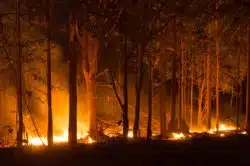
 The California Supreme Court has agreed to decide whether or not corporations responsible for starting or spreading fires, such as the Pacific Gas and Electric wildfires, can be required to pay the state’s costs of fighting those fires.
Pacific Gas and Electric has been linked to a number of major wildfires in California over the last few years, leading to tens of billions of dollars in liability for the utility company. Because of these costs, PG&E filed for Chapter 11 bankruptcy about a year ago.
The question of whether or not a corporation can be held responsible for employees negligently causing wildfires has had some disagreement. In 2017, a state appeals court in Sacramento found that under California law, the companies were not required to pay companies for the costs of fighting wildfires their employees negligently caused.
However, a ruling in November 2019 by the Second District Court of Appeal in Ventura disagreed, allowing a state agency to sue Presbyterian Camp and Conference Centers for the costs of both investigating and fighting the Sherpa fire caused back in June 2016.
Since these two lower California courts disagreed on this issue, the state’s Supreme court is going to step in and reach its own decision, effectively resolving the issue.
One of the most significant aspects of this decision will be how it affects the ongoing issue with the Pacific Gas and Electric wildfires, and whether the company can be billed for hundreds of millions of dollars by various state agencies. Cal Fire alone has sued PG&E and the employee responsible for the fire for more than $12 million.
According to a state law established in 1939, “any person” who negligently sets a fire or allows it to spread onto others’ property can be held accountable by Cal Fire for the costs. Since then, “any person” has been defined as including a company or corporation.
According to state law, a corporation like PG&E must pay the costs incurred when its employee “negligently, or in violation of the law, sets a fire, allows a fire to be set, or allows a fire kindled or tended by (them) to escape onto any public or private property,” said Justice Martin Tangeman regarding the Sherpa Fire.
The California Supreme Court is now set to resolve once and for all if corporations can be required to pay the state’s costs incurred by fires negligently set or spread by their employees.
If you have been affected by one of the recent Pacific Gas and Electric wildfires, the deadline for making these claims has unfortunately passed, but you may be able to receive further compensation.
Consulting an experienced attorney can help you determine if you have a claim, navigate the complexities of litigation, and maximize your potential compensation. Even if you have already received compensation, perhaps under your homeowners insurance, you may not have yet received all the compensation you’re actually due.
Join a Free California Wildfire Property Damage Lawsuit Investigation
If you or a loved one suffered property damage in the Camp Fire, Woolsey Fire, Hill Fire or last year’s Thomas Fire, legal help is available to help you through the claim process with your insurance company.
This article is not legal advice. It is presented
for informational purposes only.
ATTORNEY ADVERTISING
Top Class Actions is a Proud Member of the American Bar Association
LEGAL INFORMATION IS NOT LEGAL ADVICE
Top Class Actions Legal Statement
©2008 – 2026 Top Class Actions® LLC
Various Trademarks held by their respective owners
This website is not intended for viewing or usage by European Union citizens.
Get Help – It’s Free
Join a Free California Wildfire Property Damage Lawsuit Investigation
If you qualify, an attorney will contact you to discuss the details of your potential case at no charge to you.
PLEASE NOTE: If you want to participate in this investigation, it is imperative that you reply to the law firm if they call or email you. Failing to do so may result in you not getting signed up as a client or getting you dropped as a client.
E-mail any problems with this form to:
[email protected].
Oops! We could not locate your form.