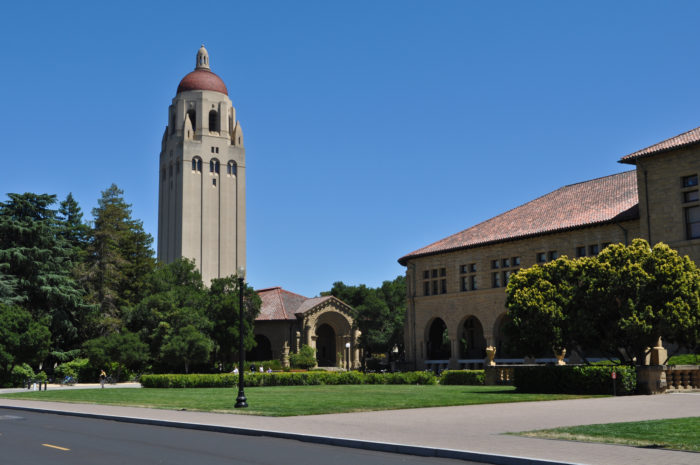
 The prestigious Stanford University has been accused of violating the Fair Credit Reporting Act by obtaining background reports on job applicants without their consent.
Plaintiff Theresa Richard claims that when she applied for a position at Stanford in June 2017, the application she filled out allowed the university to obtain her consumer report without her knowledge.
Consumer reports are employment-related background checks typically obtained through a third party.
Although she was hired as a dining hall worker in Stanford’s “residential and dining enterprises,” Richard says she was confused by the application and that it wasn’t clear that the university would be requesting a consumer report.
Under the Fair Credit Reporting Act (FCRA), an employer must clearly inform potential employees that a background check may be obtained as part of the application process. The law requires written authorization from the job applicant and forbids any “extraneous information” to be attached or included in the authorization and disclosure form.
“By including a liability release in its standard application form permitting defendant to obtain a consumer report verifying the applicant’s background and experience, defendant’s conduct is contrary to the plain language of the statute,” the Stanford class action argues.
Extraneous information included with the authorization and disclosure form is prohibited under the FCRA to prevent any distractions.
If there are other disclosures or pieces of information, job applicants may be distracted from the more important disclosure regarding the release of their personal information.
Richard argues that Stanford included additional liability release information with the consumer report disclosure, which confused her and other applicants seeking employment with the university.
“Because defendant unlawfully included extraneous information in its standard form permitting defendant to obtain a consumer report verifying plaintiff’s background and experience, plaintiff was confused by the standard form document and did not understand that defendant would be requesting a ‘consumer report’ as defined in the FCRA,” the Stanford class action claims.
Based on Stanford’s alleged violations, Richard brings claims of failure to make proper disclosure and failure to obtain proper authorization, both in violation of the FCRA.
She argues that Stanford’s authorization and disclosure forms were likely universally used, meaning that other applicants may have experienced the same confusion she did. Based on this inference, she argues that a class action lawsuit is the “most efficient and economical” method for both parties and the courts to resolve the issue.
Richard seeks to represent a Class of individuals who applied to work at Stanford and had a consumer report obtained since Aug. 16, 2015. She estimates that the proposed Class includes more than 1,000 individuals.
The Stanford FCRA class action lawsuit seeks statutory damages of $1,000 for each violation of the Fair Credit Reporting Act, punitive damages, court costs, and attorneys’ fees.
Richard is represented by Eric B. Kingsley and Kelsey M. Szamet of Kingsley & Kingsley APC; and Emil Davtyan of Davtyan PLC.
The Stanford FCRA Class Action Lawsuit is Richard, et al. v. The Leland Stanford Junior University, Case No. 5:18-cv-06611, in the U.S. District Court for the Northern District of California.
ATTORNEY ADVERTISING
Top Class Actions is a Proud Member of the American Bar Association
LEGAL INFORMATION IS NOT LEGAL ADVICE
Top Class Actions Legal Statement
©2008 – 2026 Top Class Actions® LLC
Various Trademarks held by their respective owners
This website is not intended for viewing or usage by European Union citizens.