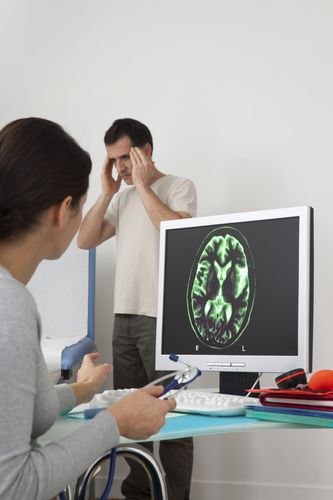
 Patients taking Dilantin (phenytoin) to control seizures may not be aware of the drug’s relationship to a type of brain atrophy that can cause a whole other set of movement problems.
What Is Dilantin?
Dilantin (phenytoin) has been in use as an anticonvulsant drug for over a hundred years. It was originally invented in 1908 by a German chemist.
Its anticonvulsant properties in animals were confirmed in 1936. Within a couple years of that, its clinical effectiveness in humans was confirmed, and Parke, Davis & Co. had begun preparing capsules ready for marketing.
What Is Dilantin Used For?
Today, Dilantin (phenytoin) is used to control some – though not all – types of seizures associated with epilepsy. The FDA has approved it as a way to control generalized tonic-clonic (or grand mal) and complex partial (psychomotor, or temporal lobe) seizures, and for the prevention and treatment of seizures that can happen during or after neurosurgery. It works by slowing down the brain activity that can cause seizures.
Side Effects of Dilantin
Like many drugs, Dilantin (phenytoin) has its share of side effects, some of which may have significant and long-lasting implications for the patient’s health.
One possible side effect that has been reported in conjunction with Dilantin (phenytoin) treatment is cerebellar atrophy. Cerebellar atrophy is a type of focal cerebral atrophy that affects the cerebellum, the part of the brain that controls posture, balance and voluntary physical movement.
Persons with cerebellar atrophy may have any of several different kinds of movement-related problems known as ataxia. They may have difficulty walking, speaking, or swallowing. Common tasks that can be required for work may be affected, such as writing, reading, or use of fine motor skills.
Often the impairment that comes with this form of brain atrophy can cause patients to suffer fatigue, since the condition requires them to expend more energy to complete ordinary tasks. Patients may also experience visual abnormalities, like blurred vision or double vision.
Some persons affected by cerebellar atrophy may even experience cognitive or emotional trouble, since the cerebellum also has a role in these functions. Patients may find it hard to do things like make plans, keep their thoughts in order, or recall newly learned information. They are also more likely to experience mood symptoms like anxiety, depression, or increased irritability.
Treatment for cerebellar atrophy can be “multi-modal,” involving a few different types of providers. Physical therapy can help the patient regain some motor control. An occupational therapist may provide help specifically geared toward restoring physical abilities useful in the workplace.
Medication or surgery may also be appropriate to help slow or stop the associated brain atrophy. A primary care physician and a neurologist may be helpful to coordinate the many different therapeutic options that can benefit the patient.
The FDA-approved labeling for Dilantin (phenytoin) states that serum levels of that drug sustained above the optimal range may produce irreversible cerebellar dysfunction in rare cases. An investigation is underway to determine whether Dilantin (phenytoin) patients who later developed cerebellar atrophy may have a legal claim they can pursue.
In general, phenytoin lawsuits are filed individually by each plaintiff and are not class actions.
Do YOU have a legal claim? Fill out the form on this page now for a free, immediate, and confidential case evaluation. The attorneys who work with Top Class Actions will contact you if you qualify to let you know if an individual Dilantin lawsuit or Dilantin class action lawsuit is best for you. Hurry — statutes of limitations may apply.
ATTORNEY ADVERTISING
Top Class Actions is a Proud Member of the American Bar Association
LEGAL INFORMATION IS NOT LEGAL ADVICE
Top Class Actions Legal Statement
©2008 – 2026 Top Class Actions® LLC
Various Trademarks held by their respective owners
This website is not intended for viewing or usage by European Union citizens.
Get Help – It’s Free
Join a Free Dilantin, Phenytoin Cerebral Atrophy Class Action Lawsuit Investigation
If you or a loved one were injured by Dilantin/phenytoin side effects, you may have a legal claim. Fill out the form for a free case evaluation.
An attorney will contact you if you qualify to discuss the details of your potential case.
Oops! We could not locate your form.