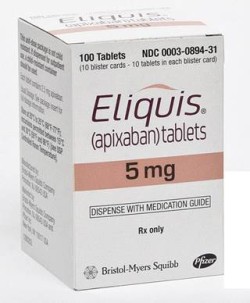
 Eliquis (apaxiban) is an anticoagulant medication used to prevent blood clots in susceptible individuals. Most commonly, Eliquis is used to prevent stroke in patients with atrial fibrillation – an abnormal heart rhythm.
With atrial fibrillation, a person’s heart beats very rapidly, causing the blood to pool in the upper chamber of the heart and not be pumped out correctly. In the areas with pooled blood, clots are more likely to form, which in turn can cause a stroke.
As a blood thinner medication, Eliquis is also used to treat and prevent deep vein thrombosis and pulmonary embolism. In deep vein thrombosis (DVT), blood clots form in the lower limbs of the body in the vein that carries blood to the heart.
As a result of DVT, a pulmonary embolism (PE) can also occur. PE happens when there is a blood clot in the lungs- a condition that is very serious and can often be fatal. Eliquis helps treat those at risk for DVT and PE and helps prevent the conditions if they have occurred.
Additionally, Eliquis is also used as a preventative measure in individuals who have undergone knee replacement or hip replacement surgeries. As a result of these major surgeries, blood clots may form, so using Eliquis can help prevent their formation.
Eliquis Bleeding Side Effects
As with any anticoagulant drug, Eliquis bleeding risk is present simply due to the way the drug works in the body.
Eliquis works by blocking certain clotting proteins present in the blood. While this is very effective in preventing blood clots that may cause stroke or pulmonary embolism, there are times when the body actually needs the blood to clot.
Clots are formed by the body to help stop bleeding. When you get a scrape, the blot will clot to prevent you from bleeding uncontrollably. Eliquis and other anticoagulants work by overriding the body’s clotting process.
The problem arises when internal bleeding occurs that is not easily detected. Patients on anticoagulants are more prone to bleeding events, and Eliquis bleeding side effects may lead to brain bleeds, gastrointestinal bleeding or other internal bleeding.
Once a bleed starts in a patient with Eliquis, there is no antidote or reversal agent to make it stop.
With warfarin, an older anticoagulant drug use almost exclusively for sixty years before Eliquis and newer oral anticoagulants were released on the market, there was an antidote to bleeding.
Fresh frozen plasma and intravenous vitamin K could quickly reverse the effects of warfarin and the blood would begin to clot again, healing the internal bleeding itself.
With Eliquis, since there is no reversal agent, a patient can only hope to be stabilized at the hospital while the Eliquis bleeding side effects wear off as the drug leaves the system. During this waiting time, permanent damage and even death may sometimes occur as a result of Eliquis side effects.
Filing an Eliquis Bleeding Side Effects Lawsuit
A number of Eliquis lawsuits have been filed alleging that the manufacturer did not adequately warn patients and physicians about the Eliquis bleeding risk that is possible with the medication nor did it warn about the lack of an effective antidote.
Lawsuits against Bristol-Myers Squibb have been filed by plaintiffs who hope to hold the manufacturer accountable for the drug they allege was unsafe, in the hope of sparing others from the risks of the drug.
If you or a loved one has suffered severe Eliquis bleeding side effects such as gastrointestinal bleeding, brain hemorrhage or other bleeding caused by Eliquis side effects, you may be entitled to legal compensation for your condition.
An experienced Eliquis lawyer can review your case at no charge to you and can help you understand your legal options should you decide to file a lawsuit against the manufacturer.
Do YOU have a legal claim? Fill out the form on this page now for a free, immediate, and confidential case evaluation. The Eliquis attorneys who work with Top Class Actions will contact you if you qualify to let you know if an individual lawsuit or Eliquis class action lawsuit is best for you. [In general, Eliquis lawsuits are filed individually by each plaintiff and are not class actions.] Hurry — statutes of limitations may apply.
Get Help – It’s Free
Join a Free Eliquis Class Action Lawsuit Investigation
If you or a loved one took Eliquis (apixaban) and suffered injuries such as uncontrollable internal bleeding, gastrointestinal bleeding, hemorrhaging, kidney bleeding or death, you may have a legal claim. See if you qualify by filling out the short form below.
An attorney will contact you if you qualify to discuss the details of your potential case at no charge to you.
Please Note: If you want to participate in this investigation, it is imperative that you reply to the law firm if they call or email you. Failing to do so may result in you not getting signed up as a client, if you qualify, or getting you dropped as a client.
Oops! We could not locate your form.
ATTORNEY ADVERTISING
Top Class Actions is a Proud Member of the American Bar Association
LEGAL INFORMATION IS NOT LEGAL ADVICE
Top Class Actions Legal Statement
©2008 – 2025 Top Class Actions® LLC
Various Trademarks held by their respective owners
This website is not intended for viewing or usage by European Union citizens.