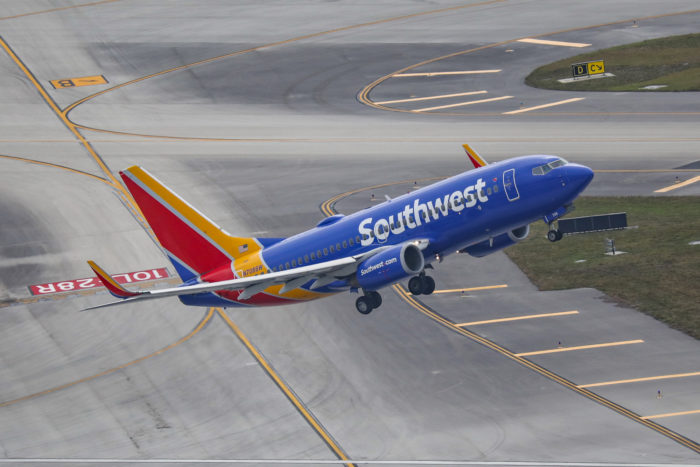
 A proposed Southwest employees class action lawsuit has been sent to arbitration instead.
U.S. District Judge Marvin E. Aspen found the claims from workers about being forced to clock in and out through a fingerprint scanner should be passed to arbitration or settled via union terms.
The Southwest employees class action lawsuit alleged that the airline carrier required employees to clock in and out with their fingerprint without ever getting express permission from the workers to do so.
The judge issued a 14-page order explaining that the case could not proceed as a Southwest employees class action lawsuit since the issues at hand relate to the bargaining agreement between the company and its employees.
Furthermore, the judge said that other issues in the case draw from the Railway Labor Act, and that, too, requires the use of formal bargaining or arbitration.
The order from the judge notifying involved parties that the proposed Southwest employees class action lawsuit would have to proceed through other resolution methods did not address the overall merits of the claims brought forward by the employees.
However, the judge did note that an additional claim in the proposed Southwest employees class action lawsuit could have involved the Illinois Biometric Information Privacy Act since the workers argue that the airline company used their fingerprints to share with third parties.
The issue at heart in the suggested Southwest employees class action lawsuit was that employees said they would have negotiated a higher pay rate due to the collection of biometric data, but the judge’s order said that this issue could not be determined without a thorough review of the collective bargaining agreement.
Another key concern, according to the judge who said the claim should not proceed as a Southwest employees class action lawsuit, is whether or not Southwest did have the right to collect this information as part of their role to “manage and direct the workforce.”
The judge says that it is possible that the collective bargaining agreement does allow Southwest to capture this personal information, but that such a document could only be reviewed through the formal bargaining process or arbitration.
Plaintiffs in the proposed Southwest employees class action lawsuit include Jennifer Miller, Scott Poole, and Kevin Englund, who worked as operations agents or ramp workers in 2005. Around one year after starting in those positions, Southwest began scanning their fingerprints daily allegedly without their permission.
Those same workers who brought forth the Southwest employees class action lawsuit say that they think the company was also using an out-of-state business to run that system and that Southwest never explained what would happen to the private data if an employee no longer worked for Southwest.
The employees are represented by Steven A. Hart, Robert J. McLaughlin, Brian J. Eldridge, Kyle Pozan, and John S. Marrese of Hart McLaughlin & Eldridge LLC.
The Southwest Employee Fingerprints Class Action Lawsuit is Miller, et al. v. Southwest Airlines Co., Case No. 1:18-cv-00086, in the U.S. District Court for the Northern District of Illinois.
ATTORNEY ADVERTISING
Top Class Actions is a Proud Member of the American Bar Association
LEGAL INFORMATION IS NOT LEGAL ADVICE
Top Class Actions Legal Statement
©2008 – 2026 Top Class Actions® LLC
Various Trademarks held by their respective owners
This website is not intended for viewing or usage by European Union citizens.

Suing for unpaid wages in California: Recover unpaid overtime, back pay and more
April 2, 2026 | Legal News