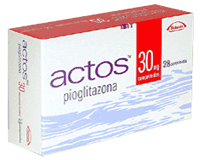
Earlier this summer, dozens of plaintiffs from the across the country filed a massive product liability lawsuit against Takeda Pharmaceuticals alleging its drug Actos caused either them or their deceased loved one to develop bladder cancer.
The 26 plaintiffs listed in the mass Actos lawsuit include some of the following claims:
- Plaintiff Henry R. from Louisiana filed on behalf of his late wife Kathleen, who took Actos from 2003 through 2009 and passed away from complications caused by bladder cancer. Henry alleges her cancer was caused by her use of Actos.
- Plaintiff Raifyeel M. from Louisiana says he took the drug from 2004 to 2006 and is in remission from Actos bladder cancer.
- Plaintiff Patricia H. from Mississippi is suing on behalf of her relative Leanora W., who ingested Actos from 2005 to 2007 and died from the alleged Actos side effect bladder cancer.
- Plaintiff Ozell B. of Kansas alleges in the Actos lawsuit that he used Actos from 2001 to 2007 and as a result developed bladder cancer.
- Texas plaintiff Maria G. is suing on behalf of the late Cresencia V. who used the drug from 1995 to 2001 and allegedly passed away from Actos side effects related to bladder cancer.
History of Actos and Bladder Cancer
The Food and Drug Administration (FDA) first approved Actos in the U.S. in 1995. Since type-2 diabetes is the fastest growing chronic disease in the United States, it was quickly a popular drug.
However, in 2011, Germany and France took action against Actos due to research suggesting an increased risk of bladder cancer in patients taking Actos. French regulators ordered Actos removed from the market. German regulators advised doctors not to put new patients on Actos.
While other countries were pulling Actos off the market, no U.S. Actos recall was issued. Instead, the FDA announced that information about an increased risk of bladder cancer would be added to the Actos drug warning label.
“However,” notes the Actos lawsuit, “from the time of Actos’ launch in 1999 until the government actions were taken in 2011, and the present, patients who were prescribed Actos developed bladder cancer because the Defendants concealed, and continue to conceal, their knowledge that Actos can cause bladder cancer.”
Even before the FDA approved the usage of the drug in the U.S., lab rats that were given Actos had developed bladder tumors. In a 2005 study, researchers noted over a three-year period that the use of Actos caused a significant increase in the risk of developing bladder cancer.
In 2010, the FDA released information from a study that indicated there was a higher risk of developing bladder cancer for those taking the drug. However, the study was never released by Takeda nor was it adequately showcased on Safety Announcements, the Actos bladder cancer lawsuit alleges.
The FDA was also behind an in-depth 10-year study ending in 2008 that showed “the risk of Actos increased with increasing dose and duration of Actos use, reaching significance after 24 months of exposure,” the Actos lawsuit says. This study was never published and the Plaintiffs claim Takeda attempted to bury such information as a means of increasing and/or maintaining profits from the drug.
Evidence in Waiting
The American Diabetes Association (ADA) got on board in 2011, pointing to the Actos bladder cancer studies and saying that it seems the drug is indeed connected to bladder cancer.
The Plaintiffs state in the Actos lawsuit, “Clearly, the relationship between Actos and bladder cancer has been known, or should have been known, to Defendants. Despite their knowledge, Defendants refused to inform patients, doctors, or the medical community about the risks and put their profits in the people.”
Not only is Actos the top-selling drug for Takeda, it’s also one of the top 10 best-selling drugs in the U.S. Plaintiffs claim in the Actos bladder cancer lawsuit that “Defendants, through fraud, negligence, misrepresentation and/or omission have concealed from patients, doctors, the medical community and the general public the true and significant risk of Actos use.”
The plaintiffs are suing for product liability in various states, violation of warranty redhibition, and any other compensation the court deems appropriate.
The Actos bladder cancer lawsuit is Case No. 6:14-cv-01235-RFD-PJH, in the United States District Court, Western District of Louisiana.
Do YOU have a legal claim? Fill out the form on this page now for a free, immediate, and confidential case evaluation. The attorneys who work with Top Class Actions will contact you if you qualify to let you know if an individual Actos lawsuit or Actos class action lawsuit is best for you. [In general, Actos bladder cancer lawsuits are filed individually by each plaintiff and are not class actions.] Hurry — statutes of limitations may apply.
ATTORNEY ADVERTISING
Top Class Actions is a Proud Member of the American Bar Association
LEGAL INFORMATION IS NOT LEGAL ADVICE
Top Class Actions Legal Statement
©2008 – 2026 Top Class Actions® LLC
Various Trademarks held by their respective owners
This website is not intended for viewing or usage by European Union citizens.
Get Help – It’s Free
Join a Free Actos Class Action Lawsuit Investigation
If you or someone you know took Actos and were diagnosed with bladder cancer or bladder tumors, legal options are available. See if you qualify by filling out the short form below.
An attorney will contact you if you qualify to discuss the details of your potential case at no charge to you.
Oops! We could not locate your form.